
Yoga Nidra Script Inspired by Nature (Free PDF + Audio)
13 years · 40+ retreats · 700+ women


I’m so glad you’re here. If you’ve been on retreat with me, you know how much reverence I have for the natural world — and this yoga nidra script and practice grew straight out of that love.
Below is a complete yoga nidra script inspired by nature, co-written with fellow retreat leader Toni Larson, and inspired by one of our favorite retreat destinations. It runs about 20–25 minutes, follows the teachings of the Bihar School in India, and moves inward through the koshas — from annamaya (the physical) to anandamaya (bliss). It’s one of the scripts my yoga teacher training students learn, and it’s yours to practice with or to teach from.
This short yoga nidra script will take approximately 20-25 minutes and its format is inspired by the teachings of the Bihar School in India and it follows an inward journey through the koshas , from annamaya kosha to anandamaya kosha.
Yoga nidra has so many benefits… from relieving stress to improving sleep and accessing that bliss state, ananda. You can read more about the benefits of yoga nidra here.
Table of Contents
- What Is a Yoga Nidra Script?
- How Long Is This Script?
- Tips for Practicing and Teaching Yoga Nidra
- The Yoga Nidra Script
- How Do You Write Your Own Yoga Nidra Script?
- Frequently Asked Questions
What Is a Yoga Nidra Script?
A yoga nidra script is a written, spoken-word guide a teacher reads aloud to lead students into yoga nidra — a state of deep, conscious relaxation between waking and sleep. A good script moves through set stages: settling in, an intention (sankalpa), a rotation of awareness through the body, breath awareness, and often guided imagery.
This particular script is built around a journey into nature, and it can be used either as a personal practice or as a teaching tool (see the usage permissions at the end).
How Long Is This Script?
This yoga nidra script takes about 20–25 minutes to read at a calm, even pace. It’s on the shorter side as far as full nidra practices go — long enough to move through all the koshas, short enough to fit into a class, a morning, or a lunch break.
Want to practice along instead of read? Get the free printable script + audio download — yours to keep, offline, no ads, anytime.
Tips for Practicing and Teaching Yoga Nidra
A few things worth knowing before you begin, whether you’re practicing or guiding:
On your language and voice (for teachers): Keep your wording simple and precise. When you are reading your yoga nidra script, avoid too much inflection in your voice. Speak clearly, with an even volume and tempo. The stillness in your voice is part of what lets students drop in.
On sankalpa: Yoga nidra is fertile ground for working with a sankalpa — a heartfelt intention phrased as a positive “I am” statement. If one doesn’t come to mind, use “I am the witness.” Sometimes you discover your sankalpa was quietly there the whole time.
If you’re facilitating: Sit upright in a position you can stay still and comfortable in. If you’re distracted by discomfort, that restlessness carries into your students. Sit on a folded blanket, bolster or block. Wear comfortable pants. And have water handy.
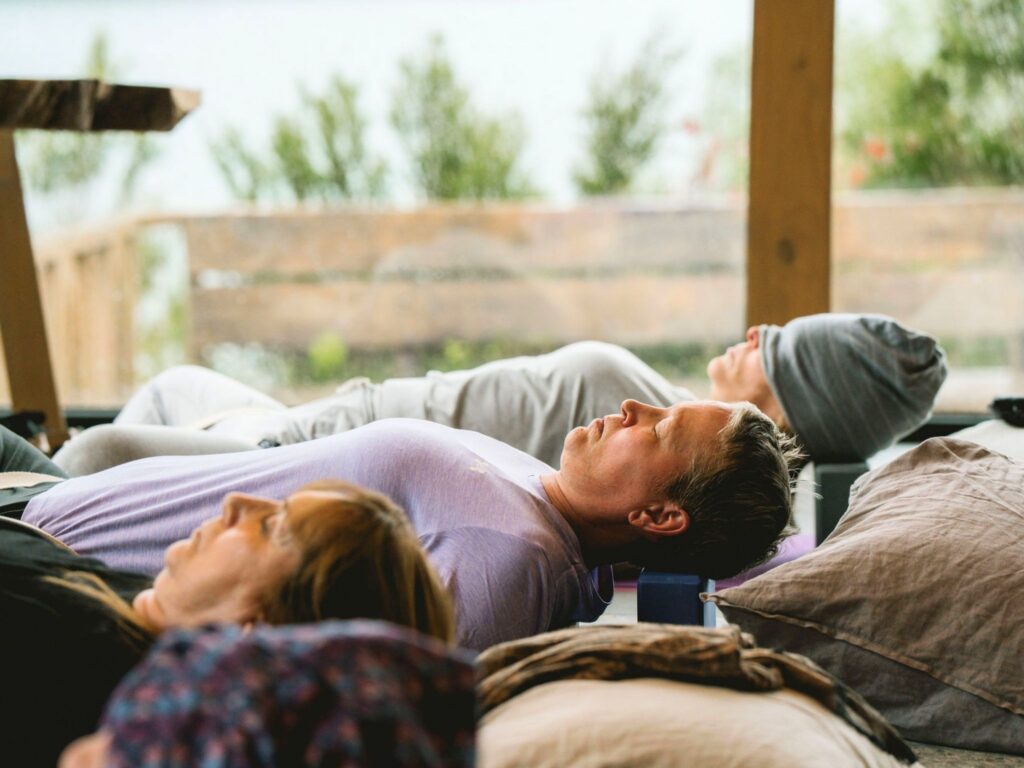
If you’re practicing: Get genuinely comfortable. A pillow under your head and a bolster under your knees eases your lower back. Your body temperature drops during nidra, so drape a blanket over yourself and add cozy socks or a warm layer. The stiller you are, the deeper it goes.
Prefer to be guided? The full audio of this practice is below.
https://www.youtube.com/watch?v=l5NIDZLw7N0u0026list=PL6X59cXieYTjQ2thxiwxB7yPJaJZthim3
The Yoga Nidra Script
Yoga Nidra Script Inspired by Nature — by Autumn Adams & Toni Larson
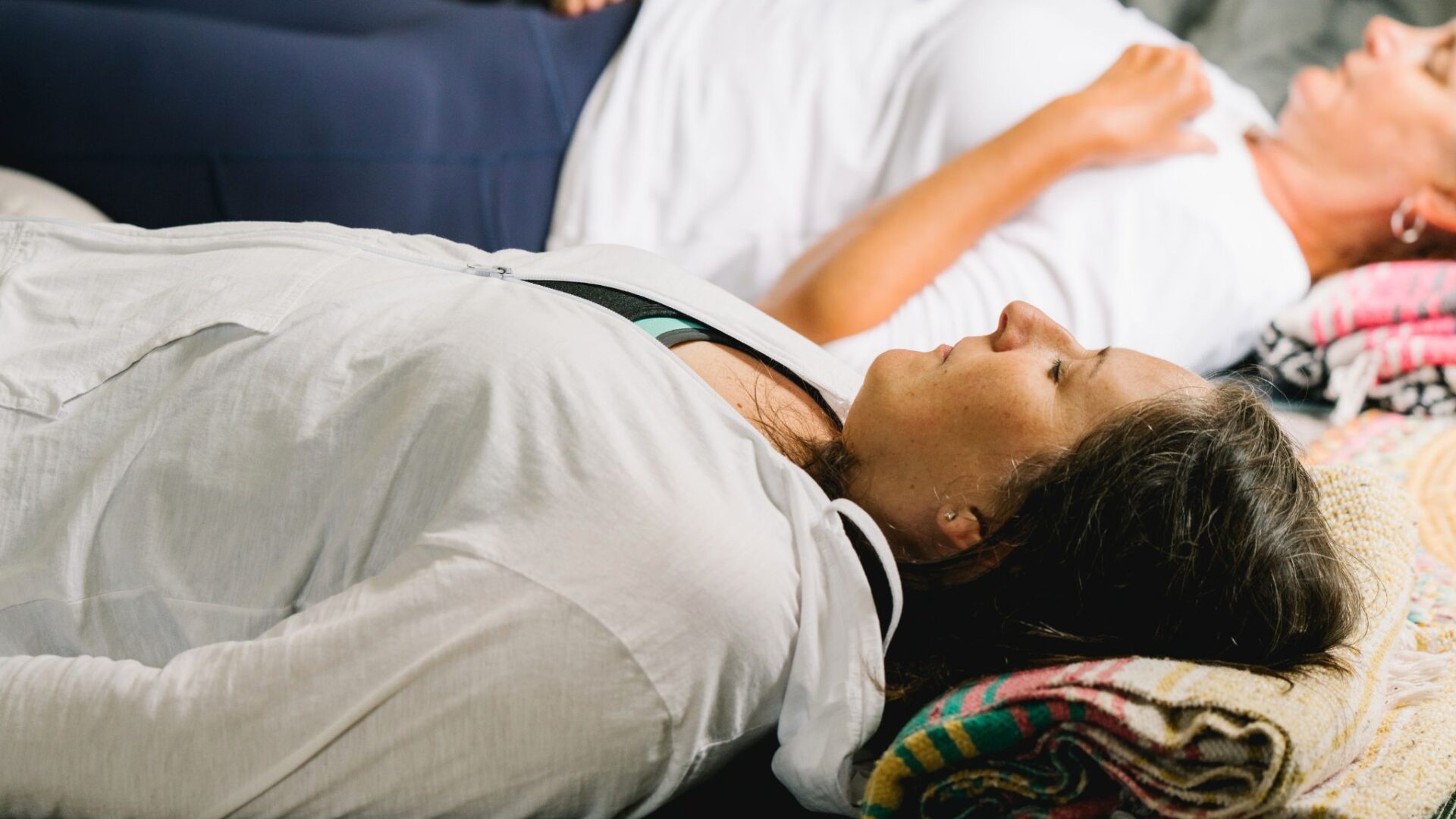
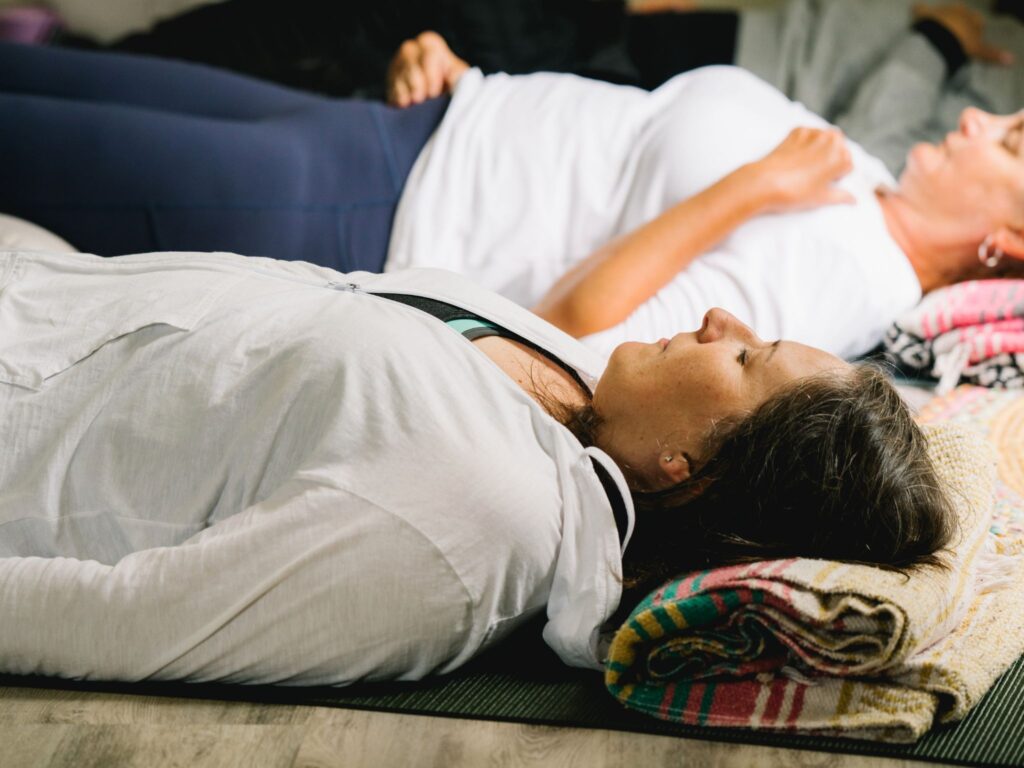
We will practice yoga nidra in Savasana, lying on your back. Please take a moment to make yourself as comfortable as possible. Use any props you have available to support your body.
Before we begin, bring into your mind’s eye your sankalpa, your “I am” statement. Repeat it quietly and internally to yourself three times. [PAUSE]
Preliminary Relaxation
As you settle into Savasana, bring your awareness to the spaces between your body and the earth beneath you. Invite your body to soften and rest. As you begin to surrender into relaxation, notice the spaces between your body and the earth beneath you becoming smaller and smaller. Your body relaxed, lying on the floor.
We will begin a rotation of awareness. All you have to do is allow your awareness to follow my voice as I guide you from point to point within your body.
Option 1 — Abbreviated Rotation of Awareness (when you’re short on time)
Right heel. Left heel. Right calf. Left calf. Right knee. Left knee. Right thigh. Left thigh. Right hip. Left hip. Both hips together. Lower back. Middle back. Upper back. Back of right hand. Back of left hand. Right wrist. Left wrist. Right forearm. Left forearm. Right elbow. Left elbow. Right upper arm. Left upper arm. Right shoulder. Left shoulder. Both shoulders together. Neck. Back of head. All points of contact with the earth. All points of contact with the earth. [PAUSE]
Option 2 — Long-Form Rotation of Awareness
Move your awareness to your mouth. Become aware of your tongue. Lower jaw. Lower row of teeth. Upper row of teeth. Gums. Upper lip. Lower lip. Space between your lips. Both cheeks. Right ear. Left ear. Forehead. Both temples. Top of the head. Back of the head. Tip of the nose. Right nostril. Left nostril. Right eyelid. Left eyelid. Right eye. Left eye. Right eyebrow. Left eyebrow. Space between the eyebrows. Now go to the right hand. The right hand thumb. Second finger. Third finger. Fourth finger. Little finger. Palm of the hand. Back of the hand. Wrist. Forearm. Elbow. Upper arm. Shoulder. Right armpit. Ribs. Waist. Hip. Right thigh. Knee. Calf. Ankle. Heel. Sole of the foot. Top of the foot. Right big toe. Second toe. Third toe. Fourth toe. Little toe. Go to the left hand. The left hand thumb. Second finger. Third finger. Fourth finger. Little finger. Palm of the hand. Back of the hand. Wrist. Forearm. Elbow. Upper arm. Shoulder. Left armpit. Ribs. Waist. Hip. Left thigh. Knee. Calf. Ankle. Heel. Sole of the foot. Top of the foot. Left big toe. Second toe. Third toe. Fourth toe. Little toe. Groin. Right buttock. Left buttock. Lower back. Mid-back. Upper back. Right shoulder blade. Left shoulder blade. Back of the neck. Back of the head. Right inner ear. Left inner ear. Roof of the mouth. Throat. Right collar bone. Left collar bone. Right chest. Left chest. Middle chest. Upper abdomen. Navel. Lower abdomen. Groin. Whole spine. The whole head. Right arm. Left arm. Both arms together. The whole right leg. The whole left leg. Both legs together. Whole front body. Whole back body. Be aware of the whole body. [PAUSE]
Breath Awareness
Now bring your awareness to your breath. Follow the gentle tide of your breath without altering it. Now, envision your breath as a golden light flowing up and down your spinal column. With your inhale, the golden light flows from the tailbone to the crown of the head. And with your exhale, it flows from the crown of the head back down to the tailbone. A cosmic tide of prana. Stay with your breath as it flows up and down your spinal column, golden, vibrant, radiant. [PAUSE]
Opposite Sensations
Now bring awareness to the sensation of heat. Your right leg warm. Your left leg warm. Both arms warm. Torso warm. The whole body becoming hot. [PAUSE]
All at once, your body becomes cold. Legs cold. Arms cold. Torso cold. The entire body cold. [PAUSE] Now let that go. [SHORT PAUSE]
Guided Imagery Journey
Imagine that you are standing outside in nature.
You feel your bare feet on the earth.
You’re standing in an open meadow surrounded by a lush forest.
You tip your face upward to feel the warmth of the sun.
Smell the wildflowers in the air.
In the distance you see a path leading into the forest.
You walk toward the path and step into the forest.
Once inside the forest, your eyes adjust to the shade of the trees.
The path continues in front of you and winds easily up the hillside.
Sunlight shines through the trees, birds sing in the distance.
You continue on the path as it climbs steadily uphill.
Near the top of the hill you see a small opening in the side of the mountain.
This opening is a cave.
You feel drawn to the cave and walk toward it.
Within the cave you see a single lit candle.
You realize you’ve stumbled into a sacred temple.
You sit down upon the earth.
A sense of calm washes over you; you feel at peace with all that is.
You need nothing from the outside world; you gaze into the candle flame.
You drop into deep meditation.
In the middle of the flame you see the purest golden seed, untouched by the flame.
On the surface of the seed, see your sankalpa inscribed.
Gaze into the flame once again. The seed is no longer in the flame.
The seed is now in your heart.
Repeat your sankalpa three times, quietly, internally, and with meaning. [PAUSE FOR FIVE MINUTES]
The practice of yoga nidra is now complete.
Gently guide your awareness back to your physical body, lying on the earth. Become aware of your breath. Your body slowly breathing in and out. Without opening your eyes, become aware of your surroundings. The earth beneath you. As your awareness comes back, invite your breath to deepen. When you feel ready, stretch your arms long overhead, extend your legs long, point your toes, and take a full-body stretch. Slowly roll over into the fetal position on your right side — a posture that resembles a newborn child or a fertile seed, a posture that symbolizes new beginnings. Take a moment here. When you’re ready, gently press up to a comfortable seat.
Practice Along (Audio)
So many of you asked for a recording, so here’s the full downloadable guided practice.
Keep it forever: Get the printable PDF + downloadable audio so you can practice offline, anytime — and teachers, so you can prep from the page.
How Do You Write Your Own Yoga Nidra Script?
To write a yoga nidra script, follow the traditional sequence: settle the body in Savasana, set a sankalpa, guide a rotation of awareness through the body, move to breath awareness, introduce pairs of opposite sensations, lead a guided visualization, return to the sankalpa, and gently bring awareness back. Keep your language simple and your pacing slow. And make sure to give your students silence and space throughout the practice.
That structure is exactly what we teach, step by step, in the yoga nidra module of my teacher training — including how to find your voice as a facilitator and write scripts that land. If guiding nidra is something you want to do well, the teacher training goes deep here.
For Practitioners: Experience This in Person
Reading a script is one thing. Being guided through nidra in a quiet room, after a day outside with no agenda, is another entirely. That’s the kind of rest we make space for on retreat. See upcoming retreats →
For Teachers: Learn to Hold This Space
If you felt something reading this — imagine guiding it. Whether you want to deepen your own practice or learn to teach nidra and lead retreats of your own, my teacher training and facilitator mentorship are where that begins.
Frequently Asked Questions
What is a yoga nidra script? A yoga nidra script is a written guide a teacher reads aloud to lead students into yoga nidra, a state of deep conscious relaxation. It typically moves through settling in, setting an intention, a body scan, breath awareness, and guided imagery.
What should I do if my students fall asleep during yoga nidra? My yoga nidra training is in the Bihar lineage, a style that explicitly asks students to remain awake. However, we don’t need to police our students’ sleep during yoga nidra, so I mention it and let it go. Learn more about sleep during yoga nidra and why it might not be such a bad thing after all.
How long should a yoga nidra script be? Yoga nidra scripts usually run anywhere from 10 to 45 minutes. This one is about 20 to 25 minutes, which is long enough to move through all the koshas and short enough to fit into a class or a busy day.
How do you write a yoga nidra script? Follow the traditional sequence: settle the body, set a sankalpa, guide a rotation of awareness through the body, move to breath awareness, introduce opposite sensations, lead a guided visualization, return to the sankalpa, and gently bring awareness back. Keep the language simple and the pace slow.
What is a sankalpa? A sankalpa is a heartfelt intention or resolve, phrased as a short positive “I am” statement. In yoga nidra, you plant it at the beginning and return to it at the end. If one does not come to mind, “I am the witness” is a gentle place to start.
What are the koshas? The koshas are five layers or sheaths of being in yogic philosophy, moving from the physical body (annamaya) inward to the bliss body (anandamaya). This script guides awareness gradually inward through these layers.
Is yoga nidra the same as meditation? Not quite. Meditation is usually practiced seated and awake, while yoga nidra is practiced lying down and guides you into a state between waking and sleep. Both calm the nervous system, but yoga nidra is specifically a practice of deep, conscious rest.
Do I need experience to practice yoga nidra? No. Yoga nidra is one of the most accessible practices there is. You lie down, get comfortable, and follow the voice. There is nothing to do correctly and no experience required.
Can I use this yoga nidra script to teach my own class? Yes, for live in-person classes only, with attribution, under the permissions below. You may not reproduce or distribute the script in any other form without written permission.
New to nidra? Read more on the benefits of yoga nidra.
Usage & Permissions
This script is copyrighted Ambuja Yoga © 2019, all rights reserved. You may use this script to guide live, in-person classes or events only. Descriptions and advertising for any live in-person class using this script in whole or in part must include one of the following attributions: script ©Ambuja Yoga used by permission, or modified from script ©Ambuja Yoga used by permission.
This use does not convey the right to borrow from this script or to reproduce it in any way. No part of this script may be reproduced, distributed, stored in a retrieval system, or transmitted in any form or by any means — including photocopying, digital copying, print, audio or video recording, or other electronic or mechanical methods — without the prior written permission of the copyright owner.
About the Author
Autumn Adams (E-RYT 500, YACEP) is the founder of Ambuja Yoga and has spent 13 years guiding women through yoga, nature, and deep rest across Oregon, North Carolina, and abroad. She’s the author of The Little Book of Mudra Meditations and teaches yoga nidra as part of her teacher trainings. This script was co-written with retreat leader Toni Larson. Meet Autumn →

Other Resources for Yoga Nidra
- Book: Yoga Nidra by Swami Satyananda Saraswati
- Book: Yoga Nidra: A Meditative Practice for Deep Relaxation and Healing by Richard Miller
- Book: Yoga Nidra: The Art of Transformational Sleep by Kamini Desai (this one is really good on Audible )
About the Author
Autumn Adams
E-RYT, YACEP, Founder of Ambuja Yoga
Autumn Adams (E-RYT 500, YACEP) is the founder of Ambuja Yoga, where she's led women's yoga retreats since 2014 — 40+ retreats and 700+ women across Oregon, North Carolina, Sedona, Patagonia, Greece, Mallorca, and Thailand. Her work has been featured in Insider, Shape, Zappos, Asia Spa, Direct Holiday, and Bend Nest, and she's the author of The Little Book of Mudra Meditations.
You Might Also Enjoy
Dharana vs Dhyana: The Difference Between Concentration and Meditation
If you’ve ever sat down to “meditate,” lasted about forty seconds before your brain wandered…

Fall Equinox Rituals: Harvesting, Herbs, and Yoga for the Seasonal Shift
Summer is softening into fall, and the plants around us are offering a quiet lesson…

The Yoga Philosophy Books That Changed How I Practice
The best yoga philosophy books don’t read like textbooks. They read like stories, and the…