
13 years · 40+ retreats · 700+ women


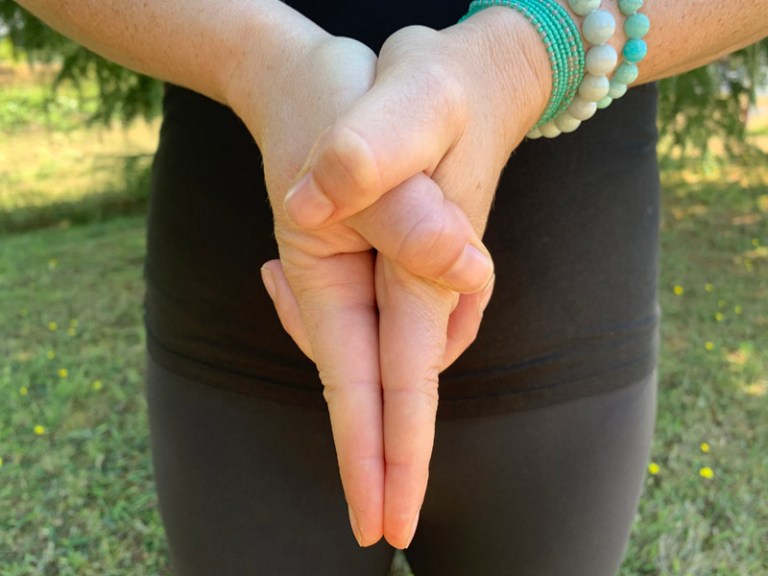
Ksepana Mudra is the mudra for letting go — and boy did I need it this week. After a rough start to my week, I could feel the frustration and overwhelm settling in like a cloud, and I knew I needed to shake it off ASAP. So this morning, I welcomed Ksepana Mudra into my meditation and asana practice. It’s one of my favorite mudras, simply because I feel the energetic shift almost immediately. The tough stuff is so much easier to move through when you have the tools to do it — and easier still to come back to feeling like yourself on the other side.
What Is the Mudra for Letting Go?
Ksepana Mudra is a hand gesture used to release what no longer serves you. In Sanskrit, Ksepana means to throw (away), to let go, to pour off, or to cast off. It’s the mudra for letting go of waste — known as mala in Ayurveda.
This waste, or mala, can be literal physical waste, toxic relationships, negative thoughts, or old habits, samskaras, and vasanas that no longer serve you. I like to use this mudra when I’m feeling heavy or down, or when I’m holding too tightly to expectations or my desire to be in control. I also love to practice it when I’m feeling grumpy, frustrated, or overwhelmed… it’s like a tonic for the soul. Give it a go and let me know how you feel afterward.
You’ll also see it spelled Kshepana Mudra. It’s pronounced roughly “kshay-PAH-nah”.
What Does Ksepana Mudra Do? (Apana Vayu)
Ksepana Mudra works with apana vayu — the down-and-outward flowing energy (prana) of elimination. Apana vayu governs elimination (defecation and urination), menstruation, and childbirth. In addition to elimination through the large intestine, Ksepana Mudra helps us remove mala through the surface of our skin via perspiration, and through our lungs via expiration (the exhale breath).
What Element and Chakra Is Ksepana Mudra Associated With?
Ksepana Mudra is most often associated with the air element and the heart chakra. Mudras are frequently linked to specific elements according to Ayurveda’s five element theory — earth, water, fire, air, and ether — and Ksepana sits with air, and therefore Anahata, the heart chakra. What a beautiful act of self-love to say, “no more, this doesn’t serve me, I’m letting it go.”
After many years of practice, though, this mudra often resonates for me with the second chakra and the water element. I find that the imagery of water helps calm my nervous system and clears out stagnation and stress. The second chakra is also very much associated with the energy of apana vayu and the act of letting go.
How Do You Practice Ksepana Mudra?
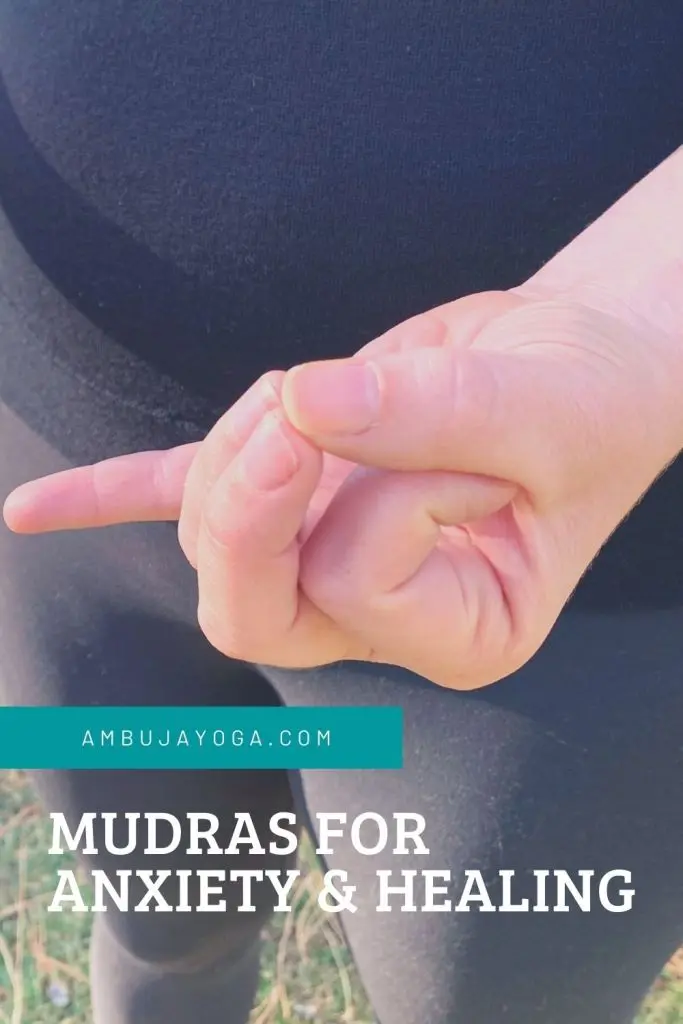
To practice Ksepana Mudra, interlace the fingers of both hands and then release the index fingers so they extend and touch one another. The thumbs cross, and the thumb pads rest, more or less, in the crook between thumb and index finger. When you’re seated, the index fingers point down. When you’re lying down, the index fingers point toward your feet.
You can also bring this mudra into your asana practice. Here’s a simple flow I love to do in a seated posture:
- Begin with the mudra at heart center, index fingers pointing up.
- On an inhale, turn the index fingers to point down and slightly away, extending the arms long toward the floor.
- Continuing the same inhale, sweep the arms up and overhead.
- On an exhale, let the index fingers travel to the crown of the head, then the forehead, the nose, the lips, and back to the heart — like a waterfall tumbling over smooth stones.
- With each inhale, envision vibrant, light energy flowing into your body. With each exhale, let go of negativity in any of its forms.
- Repeat the full sequence seven times.
What Are the Benefits of Ksepana Mudra?
Ksepana Mudra helps us release negativity, frustration, and suffering. Practicing it — especially in the flow above — creates a palpable difference in our energy. I call this letting-go mudra an “attitude adjustment.”
But here’s the part many teachers forget: letting go isn’t the destination. It’s what makes room. When the heaviness moves out, something lighter gets to move back in — a little more ease, a little more play, the version of you that laughs easily and feels like herself again. We don’t release the frustration just to be empty. We release it so we can come back to life a little.
Can Ksepana Mudra Help With Negative Thoughts?
Yes, and honestly that’s when I use it most. When my thoughts start looping (the same worry, the same frustrating conversation replaying), this is the mudra I reach for. It won’t make the thought disappear. What it does is give my body something to do with it: exhale, index fingers pointing down and away, and let it go for now. After seven rounds of the flow below, the thought usually has a lot less grip.
Affirmations for Letting Go
Pair any of these with your practice:
- “I embrace uncertainty with ease.”
- “I let go of what no longer serves me.”
- “I surrender to the flow of the Universe.”
- “Spent energy in my body, mind, and soul flows away from me, and I thankfully accept all things that refresh me.” (from Gertrud Hirsch’s book Mudras: Yoga in Your Hands. Gertrud’s book has been on my bookshelf for years and is my go-to reference for mudras.)

Frequently Asked Questions About Ksepana Mudra
Ksepana Mudra is a yoga hand gesture used to release what no longer serves you. In Sanskrit, Ksepana means to throw away, let go, or cast off. You form it by interlacing the fingers, releasing and extending the index fingers to touch, and crossing the thumbs.
Ksepana Mudra is good for releasing negativity, frustration, overwhelm, and stagnation. It works with apana vayu — the body’s downward, eliminating energy — to support letting go of physical waste, heavy emotions, and old habits that no longer serve you.
Interlace the fingers of both hands, then release the index fingers so they extend and touch. Cross the thumbs, resting the pads in the crook between thumb and index finger. Point the index fingers down when seated, or toward your feet when lying down.
Ksepana Mudra is most often associated with the air element and the heart chakra (Anahata). With practice, many people also feel it resonate with the second chakra and the water element, both of which connect to apana vayu and the act of letting go.
In a seated flow, practice the full sequence seven times, coordinating the movement with your breath — inhaling vibrant energy in, exhaling negativity out.
Not in the way a medication does. It’s a gentle practice. It’s also meant to be held briefly. Gertrud Hirschi recommends 7 to 15 breaths, focusing on your exhale, then resting your hands palms-up on your thighs. That’s why I keep my flow to seven rounds.
It’s sometimes spelled Kshepana Mudra.
Ksepana Mudra is the mudra most often used to release negative thoughts and heavy energy. It works with apana vayu, the body’s downward, releasing energy, and pairs well with a long, slow exhale.
If you want to learn more about mudras and the meditation practices you can combine with these symbolic hand gestures, check out my book, The Little Book of Mudra Meditations. And if you’re craving space to actually practice this kind of letting go — away from the noise, with other women who get it — come explore an Ambuja Yoga retreat. Sometimes one brave decision changes everything.
Hope to see you on your mat or cushion soon.
With Love,
Autumn
*Some of the links above are affiliate links, meaning, at no additional cost to you, I earn a small commission if you click through and make a purchase. These earnings help make the maintenance of this blog possible. You can rest assured that I only link to products I know and love.
About the Author
Autumn Adams
E-RYT, YACEP, Founder of Ambuja Yoga
Autumn Adams (E-RYT 500, YACEP) is the founder of Ambuja Yoga, where she's led women's yoga retreats since 2014 — 40+ retreats and 700+ women across Oregon, North Carolina, Sedona, Patagonia, Greece, Mallorca, and Thailand. Her work has been featured in Insider, Shape, Zappos, Asia Spa, Direct Holiday, and Bend Nest, and she's the author of The Little Book of Mudra Meditations.
You Might Also Enjoy
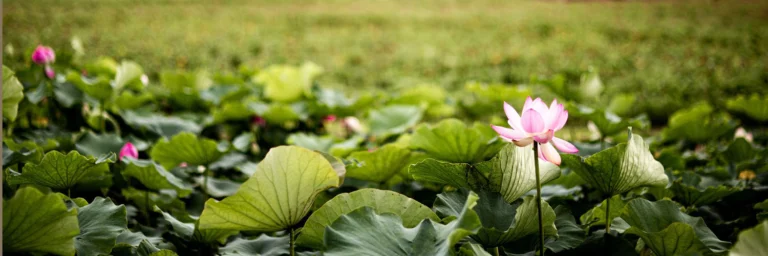
Padma Mudra: A mudra to honor your inner beauty and light
Padma mudra, is commonly known as the lotus mudra. It reminds us of the divine…
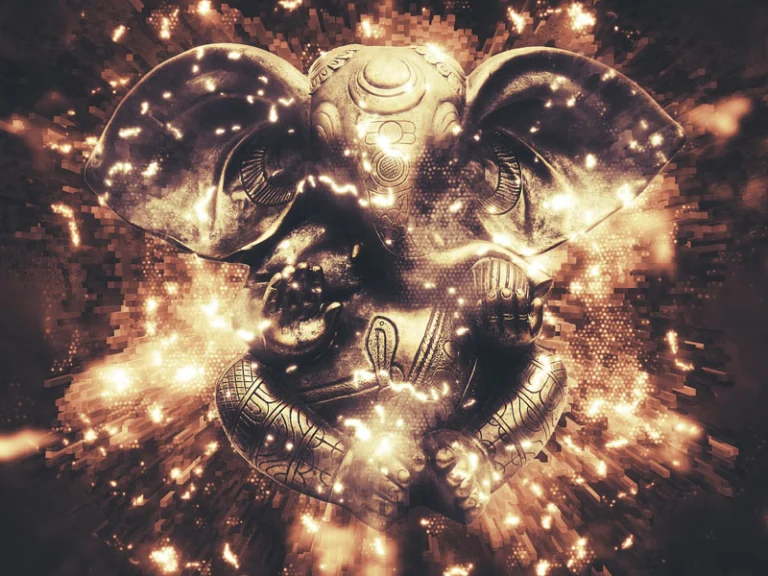
Ganesh Mudra for Courage & Confidence
Ganesha mudra helps open the heart chakra & encourages our confidence, courage, compassion, openness &…
Four Mudras for Anxiety
Anxiety and stress are at an all time high in the U.S. Try out these…