
What’s the Difference Between Yoga Nidra and Meditation?
13 years · 40+ retreats · 700+ women



Yoga Nidra vs. Meditation: What’s the Difference?
The short answer: yoga nidra is an effortless, guided practice done lying down, where you simply follow a voice into deep relaxation. Meditation is an active practice of training your attention, usually done sitting up. The simplest way to remember it: meditation takes effort; yoga nidra takes almost none.
If you’ve been around yoga for a while, you’ve probably tried both — and maybe wondered, isn’t yoga nidra just guided meditation? Sort of. They’re cousins. But they do different things, in different ways, and they’re wonderful for different reasons. Here’s the honest breakdown.
| Yoga Nidra | Meditation (most forms) | |
|---|---|---|
| Position | Lying down (in savasana) | Usually seated |
| Effort | Effortless — you follow a voice | Active — you train your attention |
| What you do | Listen and let go | Hold focus on a breath, mantra, or object |
| State of mind | Drifting between waking and sleep | Alert, focused awareness |
| If your mind wanders | Totally fine — it still works | You gently bring it back |
| Best for | Deep rest, sleep, nervous-system reset | Focus, clarity, steadiness |
| Typical length | 10–45 minutes | 5 minutes to an hour or more |
What Makes Yoga Nidra Unique?
Yoga nidra is often called “yogic sleep” or “conscious sleep” — sleep with a thread of awareness running through it. It’s a systematic practice that guides your attention from the outside world inward, moving through what yoga calls the koshas: five layers of you, from the physical body all the way in to the quietest, most peaceful part. (If you want the deep dive on those, I wrote a whole post on the koshas.)
As you settle in, your senses start to power down — a state yoga calls pratyahara, or sensory withdrawal, is the fifth limb of Patanjali’s Eight Limbed Path. In plain terms: the outside world goes quiet, and the only door left open is your hearing, so you can follow the voice guiding you.
This process of moving inward shuts down the thinking mind and into a state of pratyahara (hallelujah! — please tell me I’m not the only one whose brain likes to do, do, do). Pratyahara, known as the practice of sense withdrawal, is the fifth limb of Patanjali’s ashtanga yoga. And yoga nidra provides a systematic approach to withdraw our awareness. In yoga nidra we disengage the parts of our mind that are linked to sense perception. The only sensory input we keep “open” is the auditory channel and perhaps a little “feeling”.
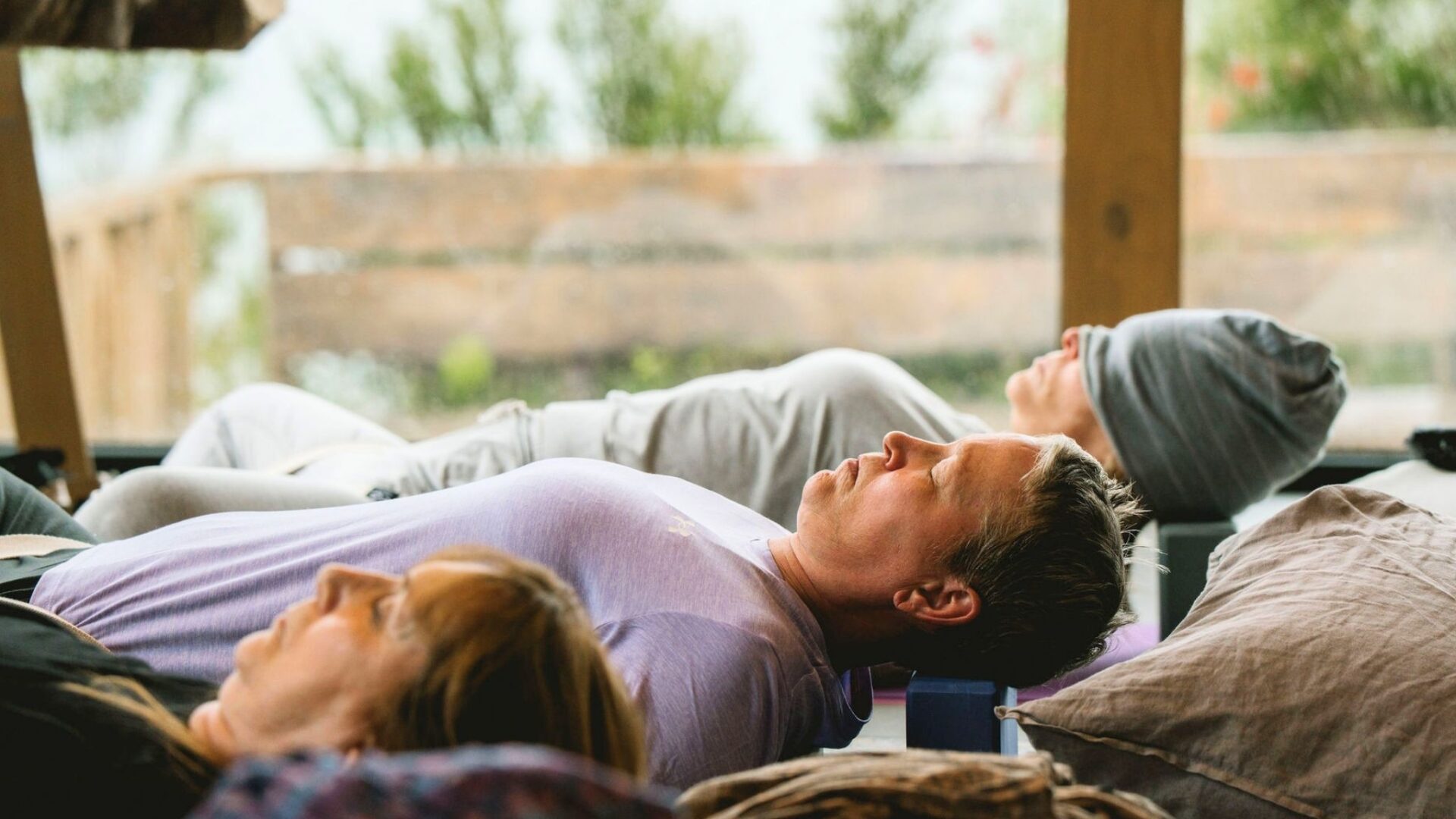
To me, yoga nidra is a receptive practice, not a focused one. It genuinely doesn’t matter if your mind drifts, or if you lose track and the dreamy subconscious takes over — the practice still works. There’s nothing to force.
And in that quiet, receptive state, something useful happens: you can begin to soften the old mental grooves you run on autopilot — yoga calls these samskaras — and, by setting a clear intention (a sankalpa), start laying down healthier samskaras in their place.
Here’s the metaphor I always come back to: yoga nidra is a game of “follow the leader” for your brain. You don’t work to hold focus — you just follow the lead of the teacher. The teacher is the gondolier, yoga nidra is the boat, and you’re simply the passenger, along for the ride.
What Makes Meditation Different?
Meditation, by contrast, is an active practice. “Meditation” has become a catch-all word that spans dozens of traditions, so it’s hard to pin down a single definition — but most forms share one thing: effort. You train your mind toward one-pointed focus, whether that’s a mantra, your breath, a candle flame, or your own thoughts. And when your attention wanders off (it will), you gently notice and bring it back. That returning, again and again, is the practice.
So where yoga nidra asks you to let go and follow, meditation asks you to focus and return. One is the passenger; the other is rowing the boat.

Yoga Nidra and Meditation are Complementary Practices
Yoga nidra and meditation both have numerous benefits and the two practices complement one another well. As a matter of fact, scientists on multiple continents are studying these two ancient practices and finding that they reduce stress, improve sleep, relieve menstrual discomfort and so on.
So Which Should You Do?
Honestly? Both — but here’s how to choose in the moment:
- Reach for yoga nidra when you’re depleted, wired-but-tired, struggling to sleep, or so overwhelmed that “just focus” feels impossible. It meets you where effort isn’t available.
- Reach for meditation when you want to build focus, steady your reactions, or train a calmer relationship with your own mind over time.
They really do complement each other beautifully. Many people find that regular yoga nidra — by calming the nervous system — actually makes seated meditation easier. You don’t have to pick a side.
What Does the Science Say?
Researchers have studied both practices, and the encouraging news is that both reduce stress and support better sleep. One 2018 trial is especially relevant here because it compared them directly: 60 college professors were split into a yoga nidra group, a seated meditation group, and a control group. Over three months, both practices reduced stress — with a tendency toward yoga nidra being slightly more effective for anxiety specifically (Ferreira-Vorkapic et al., 2018).
In other words: you really can’t go wrong. (If you want the full rundown of the research on yoga nidra, I gathered it in this post on the benefits of yoga nidra.)
Try It for Yourself
The best way to understand the difference is to feel it. Yoga nidra especially — it’s hard to describe and easy to experience.
Get my free guided yoga nidra recording →
A 20-minute practice you can do tonight, lying down. Drop your email and I’ll send it right over.
I also teach live yoga nidra on Zoom check my schedule and have on-demand sessions on YouTube. I’d genuinely love to hear how it goes for you.
Frequently Asked Questions
What is the difference between yoga nidra and meditation? Yoga nidra is an effortless, guided practice done lying down, where you follow a voice into deep relaxation. Meditation is an active practice of training your attention, usually done seated. The simplest difference: meditation takes effort, while yoga nidra takes almost none.
Is yoga nidra a type of meditation? Loosely, yes — yoga nidra is often grouped with meditation because both calm the mind and aren’t physical like other yoga. But it’s distinct: it’s done lying down, it’s fully guided, and it’s receptive rather than focused.
Is yoga nidra better than meditation? Neither is better — they do different jobs. Yoga nidra is best for deep rest, sleep, and nervous-system recovery; meditation is best for building focus and steadiness. Many people do both.
Is yoga nidra easier than meditation? For most people, yes. Because yoga nidra is fully guided and doesn’t ask you to hold focus, it tends to feel easier than seated meditation — especially when you’re tired or overwhelmed.
Should I do yoga nidra or meditation for sleep? For sleep, yoga nidra is usually the better fit. It’s done lying down and guides you into a deeply relaxed, sleep-like state, which makes it ideal before bed or during a restless night.
Should I do yoga nidra or meditation for anxiety? Both help with anxiety. One 2018 study found yoga nidra had a slight edge for anxiety specifically, and because it requires no effort, it’s often more approachable when you’re feeling anxious or scattered.

About the Author
Autumn Adams
E-RYT, YACEP, Founder of Ambuja Yoga
Autumn Adams (E-RYT 500, YACEP) is the founder of Ambuja Yoga, where she's led women's yoga retreats since 2014 — 40+ retreats and 700+ women across Oregon, North Carolina, Sedona, Patagonia, Greece, Mallorca, and Thailand. Her work has been featured in Insider, Shape, Zappos, Asia Spa, Direct Holiday, and Bend Nest, and she's the author of The Little Book of Mudra Meditations.
You Might Also Enjoy
Dharana vs Dhyana: The Difference Between Concentration and Meditation
If you’ve ever sat down to “meditate,” lasted about forty seconds before your brain wandered…
If You’re Teaching Yoga Nidra, Stop Doing This
There’s one note I give yoga teachers more than any other when it comes to…
If You’re Teaching Yoga Nidra, Stop Policing Sleep
Full disclosure, I trained in a Bihar-inspired lineage, so I do ask my students to…