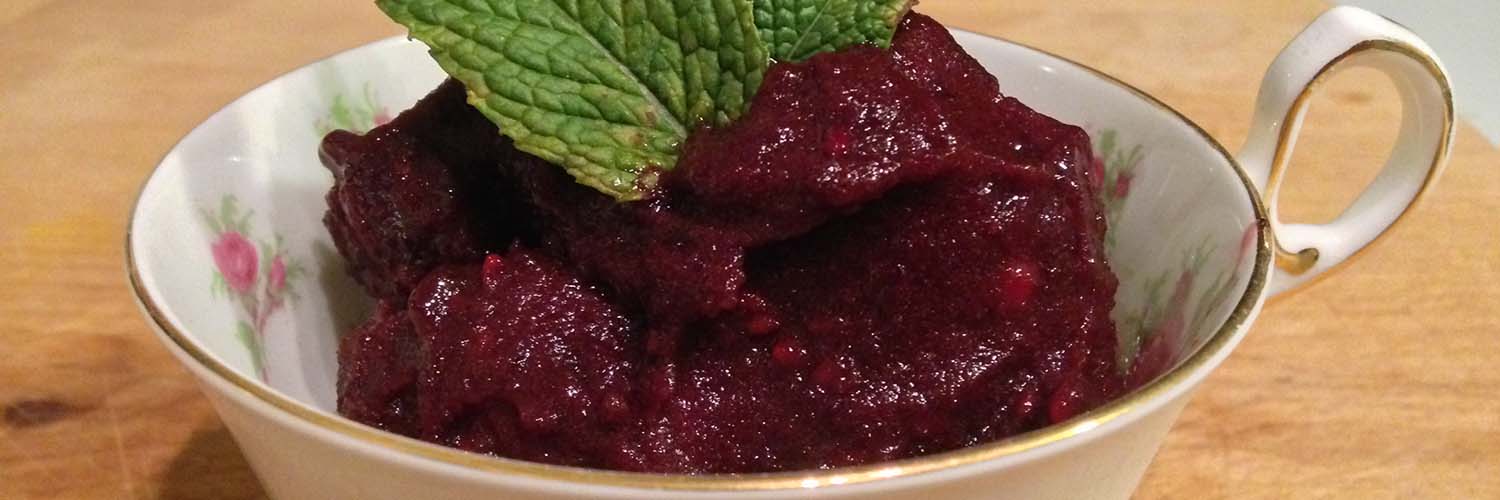
Organic Blackberry Sorbet

As the dog days of summer drag on, nothing beats the heat quite like a tasty frozen treat. Fortunately, fresh fruit sorbets are incredibly easy to make and much better on your waistline than ice cream.

organic blackberry sorbet

So delicious and so easy to make!

Since all fruit sorbet recipes follow the same basic pattern (1. make simple syrup, 2. add fruit, 3. blend and chill), you can get creative with whatever fruit is in season in your area. For this recipe, I used a a pint of delicious organic blackberries fresh from the Bend Farmer’s Market — the hardest part of this recipe was not eating all the juicy berries before the syrup was ready!

blackberry sorbet ingredientsOrganic Blackberry Sorbet Recipe

Ingredients (4 servings)

  • 1 cup water
  • 2/3 cup organic sugar
  • 1/2 organic lemon
  • 1 pint (16oz) organic blackberries
blackberry sorbet recipe mixedblackberry-sorbet-blendedblackberry-sorbet-cuisinart

Instructions

  1. Make a simple syrup by bringing the sugar and water to a boil, stirring constantly until sugar is dissolved. Remove the simple syrup from the heat and pour in a large mixing bowl.
  2. Rinse the blackberries and add to the mixing bowl. Let the blackberries steep in the hot simple syrup for about 10 minutes.
  3. Using a hand mixer, blend the berries and simple syrup into a puree. Squeeze the juice of the half lemon and stir into the mix. Cover the bowl and refrigerate the mixture for at least one hour.
  4. Start up your ice cream maker (I used a Conair Cuisinart 1.5-quart ice cream maker, which is the perfect size for this recipe). Pour the blended mixture into the ice cream maker. After 10-15 minutes of churning, the sorbet should be ready to go; check the consistency as the sorbet solidifies to get the perfect texture.
  5. Scoop out the sorbet and serve, or store in a freezer-safe container for up to 2 weeks.

A Poem for Savasana

blissful-afternoon-tea

Just For Now

Just for now, without asking how, let yourself sink into stillness.

Just for now, lay down the
weight you so patiently
bear upon your shoulders.
Feel the earth receive
you, and the infinite
expanse of sky grow even
wider as your awareness
reaches up to meet it.

 Just for now, allow a wave of breath to enliven your experience.

Breathe out
whatever blocks you from
the truth. Just for now, be
boundless, free, awakened
energy tingling in your
hands and feet. Drink in
the possibility of being
who and what you really are
so fully alive that when you
open your eyes the world
looks different, newly born
and vibrant, just for now.

By Danna Faulds

Jamu Recipe

turmeric-jamu-recipe

Jamu is a healing Balinese elixir made of turmeric, ginger, lime, tamarind and honey. I drank Jamu religiously during my yoga teacher training at Zuna Yoga, and will likely drink it religiously again this fall at my upcoming yoga retreat in Bali, Indonesia.

The flavor of Jamu, especially when it hasn’t been sweetened much, is an acquired taste for sure. Jamu packs an intense turmeric punch… made even punchier with fresh ginger added to the mix. On top of the basic ingredients you can add other spices for flavor or for Ayurvedic purposes. I like to add black pepper and cayenne to mine, and sometimes cloves. Jamu’s main ingredient, turmeric, is rich in curcumin, a fantastic anti-inflammatory. Combining turmeric with black pepper (which contains piperine) helps our body absorb the curcumin. Want to learn more about the amazing benefits of turmeric? Check out this article at AuthorityNutrition.com.

Just a few ounces of Jamu each day is enough and should be thought of as a natural medicine, so you don’t want to overdo it… although I’ve definitely guzzled it down on more than one occasion and survived.

Here is a simple Jamu recipe to follow:

Ingredients

  • 7-10 inches turmeric root, peeled and cut into 1/2 inch chunks
  • 3 inches fresh ginger, peeled
  • 3 T. tamarind paste
  • juice from 2 limes or 1 1/2 lemons
  • 1 T. honey or 1 cup of pineapple juice
  • 1 liter of water
  • Cayenne, to taste
  • Black Pepper, to taste

Instructions

  1. In a large pot on medium high heat add water and turmeric. Once the water begins to boil turn the heat down to a simmer and cover. Simmer for 18-20 minutes.
  2. Add the ginger and tamarind paste and simmer for another 4-5 minutes.
  3. Allow mixture to cool. Once mixture has cooled add the turmeric mixture and honey to your blender in batches (just a warning: if your blender is plastic it will be stained yellow afterward). Blend until smooth.
  4. Using a fine mesh strainer you will strain the ingredients over a bowl to separate the solids from the liquids. You may need to use a spatula to press some of the moisture out of the solids. Discard the solids.
  5. Add citrus juice, cayenne and black pepper to your mixture. Stir, taste and adjust… maybe add more sweetener if you feel like you need it… maybe dilute it with some extra water.
  6. Poor mixture into glass jars, seal them up and store in the fridge. Jamu will keep in the fridge for 3-5 days.


Super Fresh Farmer’s Market Salad

farmers-market-salad-recipe

I love this time of year for all of the wonderful produce we have available at the Farmer’s Market and this is one of my favorite salads. This is a recipe adapted from Kathy Casey’s Northwest Table Cookbook. I’ve made this recipe so many times I’m not sure how different it is from the original, but it is so delicious and easy. These days I need as simple as possible… otherwise I likely wouldn’t feed myself.

Farmer’s Market Salad (Serves 4)

Salad Ingredients

  • 2 ears of corn, husked
  • 2 bell peppers (your choice, but I like red and yellow best)
  • 2 large heirloom tomatoes, sliced into 1/3 inch slices
  • 1/3 cup garden fresh basil, chopped

Dressing Ingredients

  • 1 clove garlic, minced or pressed
  • juice from 1/2 lemon
  • 3 T. olive oil
  • 1.5 T balsamic vinegar
  • 1-1.5 t. honey
  •  2 t. stone ground mustard
  • salt and pepper to taste

Serve with sliced baguette.

Instructions

  1. Prepare your dressing. Combine all of the dressing ingredients in a medium size bowl and whisk until well blended. Add salt and pepper to taste.
  2. Turn grill onto high heat. Brush corn with a little olive oil and grill. Grill until each side is marked. Set aside. Once cool slice the corn from the cob and put in the bowl with the dressing.
  3. Grill peppers next using high heat until the skins are blistered. Brush with olive oil as necessary. Once cool remove the skins and seeds. Slice the peppers into 1/4 inch thick strips. Add the peppers to the dressing and stir gently.
  4. Allow the corn and peppers to sit in the dressing for 15-30 minutes. Add the basil just before serving.
  5. On a large plate or medium sized platter lay out your heirloom tomatoes and top with the corn and pepper mixture. Garnish with any extra basil leaves and dig in!
Steve Craig
Latest posts by Steve Craig (see all)

Chin vs. Jnana Mudra

Mudras are powerful tools for healing and they’re often overlooked by both yoga instructors and yoga students. I completely overlooked the power of mudras the first few years I was teaching. Fortunately, they are part of my current practice.

This is the first of hopefully many posts about mudras. My hope is that every other Monday I will offer a different mudra and offer ways to incorporate it into your practice, perhaps in asana, meditation or in combination with a mantra. One of my favorite resources is Mudras: Yoga in Your Hands by Gertrud Hirschi. Her instructions are clear and descriptive. If you’re in the market to pick up a mudra book, I recommend hers.

In this post, we’ll explore the difference between chin and jnana mudra. These two mudras are often used interchangeably and honestly, they’re almost identical, so it makes sense that there is a bit of confusion.

hand-yoga-mudra

Chin Mudra

Chin Mudra is one of the most common mudras… even non-yogis have seen this mudra in contemporary art and culture. Chin means “consciousness” in Sanskrit and this mudra is often called the “psychic mudra of consciousness” or “the gesture of the teacher”.

To practice chin mudra while seated guide the tip of your index finger to the pad of your thumb, turn the palms up and rest the backs of your hands on your knees. Chin mudra can also be practiced in asana. I enjoy practicing chin mudra in dancer’s pose and reverse warrior among others.

According to the yoga tradition, the middle finger, ring, and pinky finger represent the three classic qualities of all of nature (the Three Gunas). The middle finger symbolizes sattva (purity, wisdom and illumincation), the ring finger rajas (action, passion and chaos) and the pinky finger tamas (inertia, lethargy and darkness). In this mudra, we unite the individual soul (index finger) with the supreme soul (thumb).

In the classical yoga text of Patanjali, The Yoga Sutras, the yogi is on a path of transcendence through these states (the gunas) and progresses from darkness into light and from ignorance to wisdom.

Benefits of Chin Mudra

  • Creates a Pranic circuit, which maintains and redirects the prana, or life force, within your body
  • Increases concentration
  • Lifts dull energy, improves stamina
  • Elevates mood (Yoga Journal)
  • Those who practice chin mudra may even find that they have better sleep patterns
  • Relieves stress and tension (Source: YogaWiz)

healing-hand-mudras-jnana-gyan

Jnana Mudra (Gyan Mudra)

Jnana means wisdom or knowledge in Sanskrit and mudra means seal or gesture. The thumb represents the supreme soul and the index finger the individual soul. This mudra represents the wisdom of knowing the individual soul is one with the supreme soul. The three extended fingers represent the three gunas which must be overcome: sattva (middle finger), rajas (ring finger) and tamas (little finger).

Jnana Mudra is nearly identical to chin mudra except the palms are turned down. Jnana mudra is typically performed in meditation due to it’s calming and grounding nature

Benefits of Jnana Mudra

  • Creates a Pranic circuit, which maintains and redirects the “Prana” within your body
  • Calms and stabilizes the mind
  • This mudra has a grounding energy
  • “Jnana Mudra symbolizes destruction of ego, as the index finger is held down and conquered by the thumb.” (Source: Yoga Wiz)
  • Creates mental peace and alleviates nervous tension
  • Boosts memory

Incorporate these hand mudras into your practice and let me know how it goes.

Love and Light,

Autumn

*Some of the links above are affiliate links, meaning, at no additional cost to you, I earn a small commission if you click through and make a purchase. These earnings help make the maintenance of this blog possible. You can rest assured that I only link to products I know and love.