
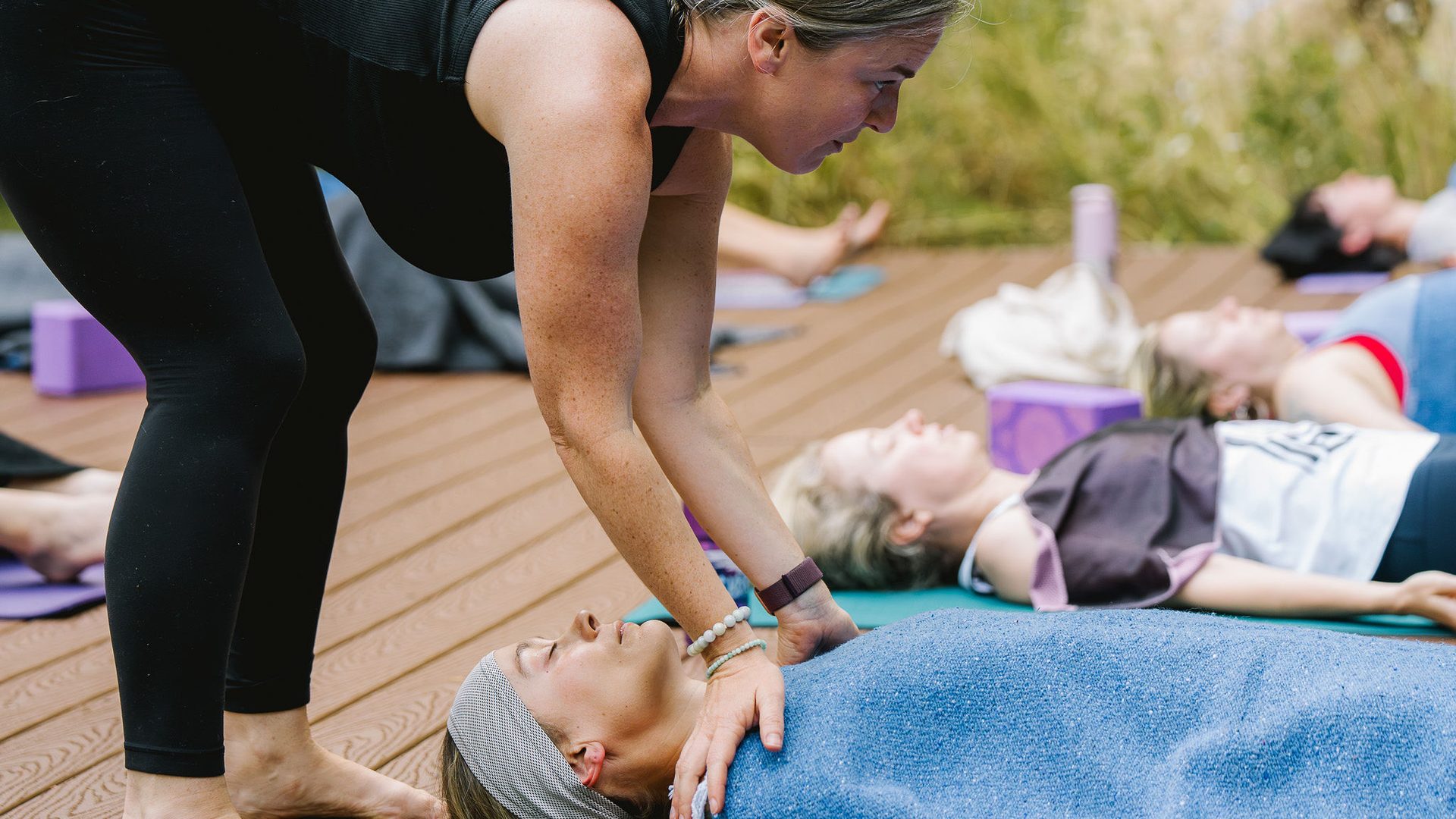
If You’re Teaching Yoga Nidra, Stop Doing This
13 years · 40+ retreats · 700+ women



There’s one note I give yoga teachers more than any other when it comes to yoga nidra, and it has nothing to do with their script, their sequencing, or their voice.
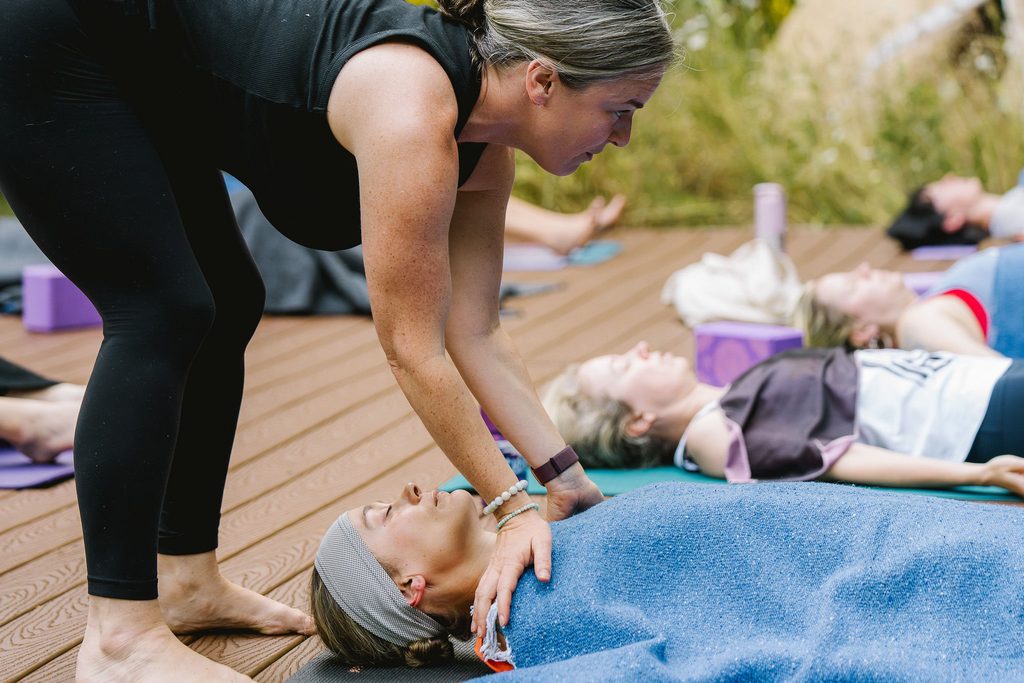
It’s this: stop filling every second with words.
Most nidra I hear taught is continuous. Beautiful language, correct structure, warm voice — and never more than three or four seconds of quiet from beginning to end. The teacher is doing everything right on paper. And the room never quite goes under.
If you’ve been guiding nidra for a while and you have the vague sense that your students enjoy it but don’t drop — this is almost always why.
What is the most common mistake when teaching yoga nidra?
Talking too much. Specifically, leaving too little silence between instructions.
Yoga nidra works by guiding a student to the threshold between waking and sleeping and then leaving her there, conscious. Your voice gets her to that edge. The silence is where she actually goes over it. If the next sentence arrives before she’s had time to arrive, you’ve called her back before she ever left.
Rhythm, cadence and the art of the pause will transform your students’ yoga nidra experience, so this is where you should refine your delivery.
Filling every second is the mistake that survives training, because nothing about it looks like a mistake. Your script is fine. Your students say it was lovely, but they don’t really drop in.
Why does silence matter so much in yoga nidra?
The state you’re after can’t be instructed into existence. It has to be allowed to happen, and that takes unfilled time.
Think about what you’re actually asking for. In the rotation of awareness, you name a body part and the student’s attention has to travel there and land. That’s not instant. In the sankalpa, you’re asking her to repeat a phrase internally three times with meaning — which takes about twelve seconds if she’s doing it properly, and about one second if you’ve already moved on. In the visualization, you’re asking her to build an image. Every one of these is a task with a duration, and we routinely give them no duration at all. You want to pause just long enough without giving their brain too much time to wander.
There’s also a mechanical piece. The sleep-onset transition — the drowsy, image-rich, threshold state that nidra is aiming at — is genuinely fragile. It reverses easily. A voice is a sound, and sound is one of the reliable things that pulls a nervous system back toward waking. Every sentence you speak is a small tug in the wrong direction. Necessary tugs, most of them. But you want fewer of them than feels natural.
What does the research actually say?
The strongest evidence is Kjaer and colleagues (2002), who used PET imaging during yoga nidra and found roughly a 65% increase in endogenous dopamine release in the ventral striatum, alongside a measurable drop in readiness for action. That’s a real, physiological shift into a distinct state — not just a nice lie-down. It’s also the finding that makes the case for silence, because that shift takes time to develop and is not something a student can be talked into.
Two other threads are worth knowing about. The sleep-onset literature describes the hypnagogic transition as unstable and easily reversed by external stimuli. And there’s evidence the brain continues processing the meaning of speech even as a person drifts toward sleep. Read that second one carefully: it means your students’ language networks stay engaged while you’re talking, whether they seem “out” or not. Continuous speech keeps a part of the brain working that you are specifically trying to let go quiet.
I will say that there are no studies that tess pause length in yoga nidra scripts and tell us the right number of seconds. That research doesn’t exist. What we have is the physiology of the state, the tradition’s own instructions, and what you can observe in your own room. Everything below is that — reasoned practice, not proven protocol. Treat the numbers as a starting place and adjust to what you see.
Why do teachers over-talk in nidra?
Because silence feels like you’ve stopped teaching. I remember dealing with this too; whether I was teaching yoga nidra or an asana class, I felt like I had to talk and fill the space because I carried the belief that I wasn’t a good teacher if I couldn’t or didn’t.
You’re the only person in the room who’s awake and responsible. Ten seconds of quiet feels endless from the seat you’re in — you’re tracking the clock, tracking the room, wondering whether someone thinks you’ve lost your place. Meanwhile the woman on the mat has no idea how long anything is taking, because time perception is one of the first things to go in that state.
The other cause is the scripts themselves. Nidra scripts are written as continuous prose, so they read as continuous prose. Even the pause markers are usually just the word [PAUSE] — which tells you that to stop, but not how long. So you stop for a breath, because a breath feels like a pause, and you carry on.
My own nature-inspired script does this, and I’m not exempting myself. Go look at it: the markers are there, unquantified. Below is how I’d time them.
How long should the pauses be in yoga nidra?
Here’s where I’d put actual seconds, stage by stage. These are for a 25–30 minute practice.
| Stage | Pause | Why |
|---|---|---|
| After settling into Savasana | 20–30 sec | She needs time to genuinely stop moving before anything else can happen. |
| Rotation of awareness | No long pauses — keep it brisk | This is the exception. In the Bihar School method the rotation is meant to be rhythmic and quick. Slowing it down lets the mind catch up and start thinking. Steady pace, no gaps. |
| Sankalpa (each of three repetitions) | 10–15 sec each | Three real repetitions take about 45 seconds total. Most of us give about five. |
| Breath awareness / counting | 45–90 sec | Long enough that she loses count. Losing count is the point. |
| Each pair of opposite sensations | 15–20 sec | The sensation has to actually build before you flip it. |
| Each image in the visualization | 5 sec | She’s constructing a scene. That takes longer than reading the line describing it. |
| Final image before return | 3–5 min | This is the deepest point of the practice. Do not rush the bottom. |
| Before externalizing | 30–45 sec | Coming back too fast is disorienting and undoes some of the benefit. |
Add it up: a well-paced 30-minute nidra can be a third to nearly half silence. If your 30-minute script takes 30 minutes to read aloud at a conversational clip, you’re teaching a very nice guided relaxation. It isn’t nidra yet.
The practical fix: write the seconds into your script. Not [PAUSE] — [PAUSE — 20 sec]. Then read the whole thing aloud with a timer before you ever teach it.
The discomfort test
Here’s the thing I’d most want you to take from this post, and it’s the one I use myself:
If the silence feels slightly too long to you, it’s probably about right for her.
You’re awake, alert, and holding the room. She’s at the edge of sleep, where time stretches. Your discomfort is not information about her experience. It’s information about yours — and it’s the single most reliable signal you have that you’re finally giving her enough room.
So when that itch arrives to say the next line, wait through it. Count if you need to. The itch is the practice working.
Want a script to practice this on?
My nature-inspired yoga nidra script is free — printable PDF plus the full audio — and it’s built on the Bihar School structure with the pause points already marked. Take it, add the seconds from the table above, and read it aloud with a stopwatch.
Read the blog where I share the script or get the free script + audio delivered to your inbox below.
Will my students think I’ve forgotten where I am?
No, that’s the fear underneath the over-talking.
A student in nidra has substantially reduced time perception and no expectation of pace. She isn’t holding your script in her head. She has no idea whether ten seconds or ninety have passed, and if she’s genuinely dropped, she isn’t tracking anything at all.
The students most likely to notice a long silence are the ones who haven’t gone under yet — which is exactly the group who need more silence, not less.
If it helps, you could say something at the start like“There will be long stretches of quiet in this practice. That’s on purpose. You don’t need to do anything with them.” One sentence at the front buys you all the room you need.
What changes when you get this right
The reports change. Students stop saying “that was so relaxing” and start saying things they can’t quite explain or don’t have the words for — that they lost time, that they’re not sure whether they slept, that they went somewhere, that something unexpected came up. Sankalpa work starts to land instead of just being a fleeting phrase. People get up slowly.
That’s the practice doing what it’s supposed to do. And most of the time, the only thing standing between a good nidra teacher and that outcome is a willingness to sit in quiet longer than feels comfortable.
Your voice gets them to the edge. Give them the room to go over it.
Frequently asked questions
How long should the pauses be in yoga nidra?
For a 25 to 30 minute practice: 20 to 30 seconds after settling in, 10 to 15 seconds for each sankalpa repetition, 45 to 90 seconds for breath awareness, 15 to 20 seconds for each pair of opposite sensations, 15 to 30 seconds for each visualisation image, 3 to 5 minutes at the deepest point, and 30 to 45 seconds before coming back. The rotation of awareness is the exception and should stay brisk and rhythmic.
How do you time pauses in yoga nidra without watching a clock?
Count your own breath. A slow breath cycle runs roughly four to six seconds, so four breaths is about 20 to 25 seconds and ten breaths is close to a minute. This keeps you internally paced rather than glancing at a phone, which pulls you out of the room. Write the intended seconds into your script, rehearse it with a timer beforehand, and by the third or fourth time you teach it the timing sits in your body.
Can you play music during yoga nidra?
You can, but choose carefully, because music fills the silence the practice depends on. If you use anything, keep it to a single sustained drone with no melody, no rhythm and no changes, played very quietly. Melodic music gives the thinking mind something to follow and track, which works against the state you’re guiding towards. Traditional yoga nidra is taught without music at all, and it’s worth teaching it that way at least once to feel the difference.
Should the rotation of awareness be slow in yoga nidra?
No. The rotation of awareness is the one stage that should stay brisk. In the Bihar School method the rotation is rhythmic and quick, which keeps the thinking mind from catching up. Long pauses belong elsewhere in the practice, particularly around sankalpa, breath awareness and visualisation.
How long should a yoga nidra practice be?
A full traditional practice with all its stages usually runs 25 to 45 minutes. Shorter forms of 11 to 20 minutes are common and can be effective, but the stages have to be genuinely shortened rather than simply read faster, because the pauses are part of the practice rather than gaps between instructions. If a 30 minute script takes 30 minutes to read aloud at a conversational pace, it’s being rushed.
Should you read a yoga nidra script or memorise it?
Read it, particularly while you’re still building experience. Everyone in the room has their eyes closed, so nobody knows or minds. Reading protects your pacing and stops you improvising extra words to fill a silence that felt uncomfortable, which is the most common way a nidra gets over-talked. Mark your pause lengths directly on the page so the silences are part of what you’re reading.
How do you learn how to teach yoga nidra?
Start by practising nidra regularly yourself, then learn the traditional structure: settling, sankalpa, rotation of awareness, breath awareness, opposite sensations, visualisation and return. Read scripts aloud with a timer to build a sense of pacing. Formal training matters here because guiding nidra depends more on facilitation and timing than on the words themselves.
Do you need a certification to teach yoga nidra?
There’s no single governing body for yoga nidra and no legally required certification, so any qualified yoga teacher may guide it. That makes the quality of your training the thing that matters rather than the credential itself. Most general teacher trainings cover nidra only briefly, so if you intend to teach it regularly, look for a training that treats it as a subject in its own right.
Where to go next
- New to nidra, or want the science in more depth? The benefits of yoga nidra →
- Want the full script? Yoga nidra script inspired by nature (free PDF + audio) →
- Curious about nidra for intention work? Yoga nidra for manifestation →
- Already teaching yoga nidra? Stop policing sleep →
Learn to teach nidra properly
Pacing is one piece. Finding your facilitator voice, writing scripts that hold up, guiding sankalpa work, knowing what to do when someone cries or snores or leaves — that’s the rest of it, and it’s what we work through in the yoga nidra module of my 200-hour teacher training for women.
References
- Kjaer TW, Bertelsen C, Piccini P, Brooks D, Alving J, Lou HC. “Increased dopamine tone during meditation-induced change of consciousness.” Cognitive Brain Research 13(2):255–259, 2002. DOI: 10.1016/S0926-6410(01)00106-9
- Ogilvie RD. “The process of falling asleep.” Sleep Medicine Reviews 5(3):247–270, 2001. DOI: 10.1053/smrv.2001.0145
- Kouider S, Andrillon T, Barbosa LS, Goupil L, Bekinschtein TA. “Inducing task-relevant responses to speech in the sleeping brain.” Current Biology 24(18):2208–2214, 2014. DOI: 10.1016/j.cub.2014.08.016
About the Author
Autumn Adams
E-RYT, YACEP, Founder of Ambuja Yoga
Autumn Adams (E-RYT 500, YACEP) is the founder of Ambuja Yoga, where she's led women's yoga retreats since 2014 — 40+ retreats and 700+ women across Oregon, North Carolina, Sedona, Patagonia, Greece, Mallorca, and Thailand. Her work has been featured in Insider, Shape, Zappos, Asia Spa, Direct Holiday, and Bend Nest, and she's the author of The Little Book of Mudra Meditations.
You Might Also Enjoy
Dharana vs Dhyana: The Difference Between Concentration and Meditation
If you’ve ever sat down to “meditate,” lasted about forty seconds before your brain wandered…

The Yoga Philosophy Books That Changed How I Practice
The best yoga philosophy books don’t read like textbooks. They read like stories, and the…
If You’re Teaching Yoga Nidra, Stop Policing Sleep
Full disclosure, I trained in a Bihar-inspired lineage, so I do ask my students to…