
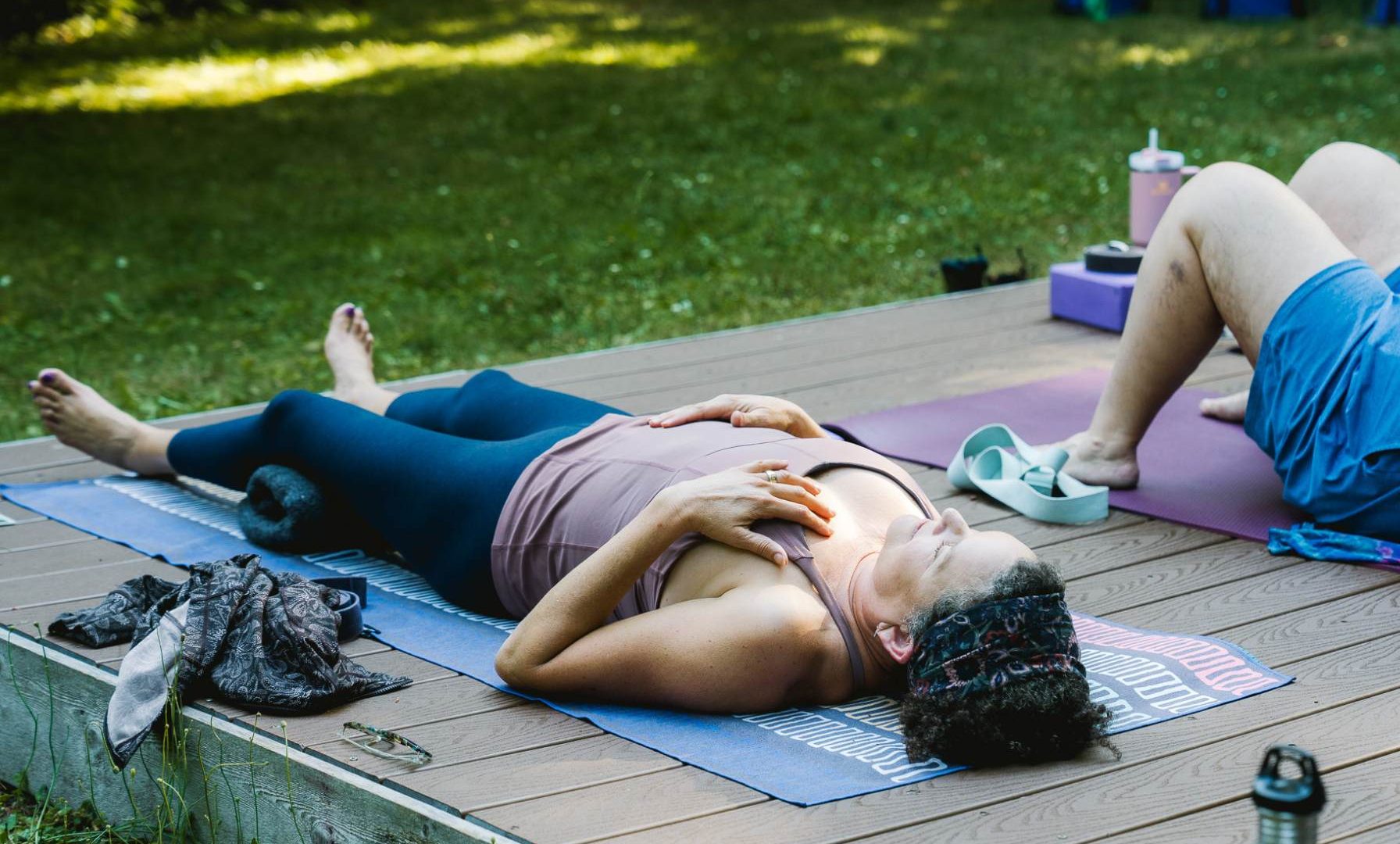
If You’re Teaching Yoga Nidra, Stop Policing Sleep
13 years · 40+ retreats · 700+ women



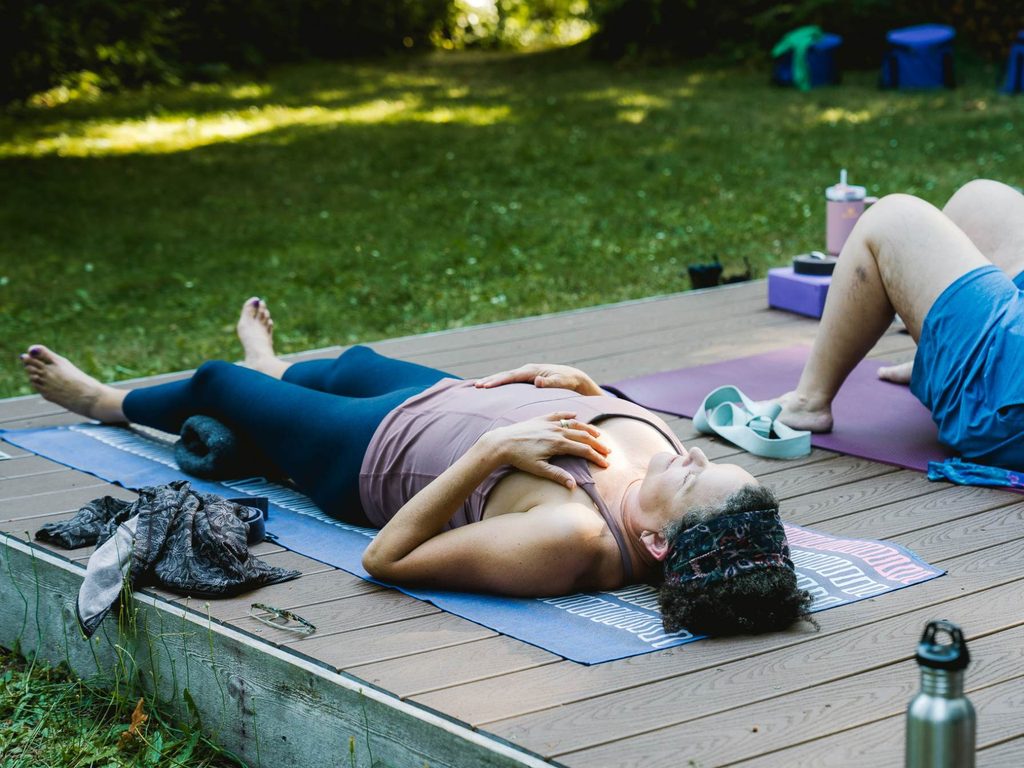
Full disclosure, I trained in a Bihar-inspired lineage, so I do ask my students to remain awake. Once when I’m explaining the practice, and usually once more right before we drop in: this isn’t sleep — see if you can stay on just this side of sleep.
Then I let it go. And here’s what I’ve realized after thirteen years of watching rooms full of tired women fall asleep during yoga nidra:
If a woman can fall asleep on the ground, outside, surrounded by women she met yesterday (or even just an hour ago)— that is not a practice that failed. Nor has she failed. In fact, it’s the single best piece of evidence I will ever get that she feels safe and that the container has done its job.
She needed the sleep. And her nervous system had to come all the way down before she could take it.
Is it bad if students fall asleep during yoga nidra?
No, it isn’t inherently bad. Is it conscious rest? No. But it usually means one of two things, and both are good news.
The first is obvious: she’s exhausted. Most of the women I teach are carrying a sleep debt that no single night of “good” sleep can touch. When the lights go down and someone else is finally in charge of the next twenty-plus minutes, the debt collects. That’s the body doing exactly what it should.
The second one is the one most yoga nidra teachers miss. Sleep does not happen in an activated nervous system. It can’t. Arousal and sleep onset are mutually exclusive, and the arousal has to come down first — not as a metaphor, as a precondition. So if she fell asleep on a floor, in an unfamiliar room, among people she barely knows, something in her genuinely downshifted. You can’t instruct that. You can only build the conditions that allow it, and if it happened, you built them
The research on this is better than you’d expect
The best-established finding in insomnia research is that people who can’t sleep are aroused — and not just in their heads.
Riemann and colleagues reviewed the evidence and found support for hyperarousal at every level they looked, from the molecular up through the whole system, with autonomic, neuroendocrine, neuroimmune, electrophysiological and neuroimaging studies all converging on elevated arousal in people with insomnia. A 2023 update calls increased arousal one of the most consistent findings the field has produced.
If elevated arousal reliably blocks sleep, then sleep arriving is evidence that arousal came down. You don’t have to take her word for how she felt. Her physiology already answered.
There’s a second finding worth knowing, and it explains why this is harder in your room than in her own bed. Sleep researchers call it the first-night effect — people sleep badly the first night in a new place. Tamaki and colleagues used brain imaging to show why: in an unfamiliar environment, one hemisphere stays measurably more vigilant than the other during deep sleep, acting as a kind of night watch. It runs automatically on novelty, and it fades once the place stops being new.
Which sets the bar higher than you’d think. Her brain arrives in your unfamiliar room running a protocol designed to keep her from going all the way under. If she does anyway, she cleared an obstacle her nervous system put there on purpose. And on retreat, when night three is easier than night one, that’s the same protocol standing down as the place becomes familiar.
One thing to note: the hyperarousal work studies people with insomnia, and the first-night research was done overnight in sleep laboratories. Nobody has studied either in a yoga room at four in the afternoon. I’m reasoning across from one setting to another, and you should hold it as a mechanistically sound argument rather than a proven finding. Worth saying too: the Tamaki team specifically argue the first-night effect is not driven by conscious anxiety — it tracks novelty rather than how nervous anyone reports feeling. So the honest version of my claim isn’t that she consciously felt safe. It’s that her arousal came down far enough for sleep, in a setting built to prevent exactly that.
So why say anything about staying awake at all?
Because the awareness is where the value lives, and the tradition is right about that.
In the Bihar School method, yoga nidra is explicitly distinguished from sleep. Swami Satyananda is direct about it, and do not sleep appears in the traditional scripts. If you trained in that lineage you were taught it for a good reason. Conscious rest and unconscious rest are different practices with different benefits, and only one of them lets a sankalpa land.
So I’m not arguing you should drop the instruction. I say it. Say it.
I’m arguing about everything that happens after you say it.
Where teachers actually go wrong
Not in giving the instruction. In repeating it, and in what we do with our faces when it doesn’t work.
Here’s what policing sleep looks like in practice. You say it at the start. Then again after the rotation. Then again before the visualization, with a little more emphasis, because you can hear breathing change in the back row. By the fourth time there’s an edge in your voice that everyone still conscious can hear clearly.
Every one of those repetitions is an interruption. And it lands hardest on exactly the wrong people — the women who were settling, who now have to surface, register an instruction, and check whether they’re doing it right. The ones already asleep hear none of it. You’ve woken your best students to police your most tired one.
There’s a deeper problem with repeating it, too. You’re asking for a state that depends on the release of effort, and try harder to stay awake is a request for effort. Vigilance is arousal. Arousal is the thing standing between her and the threshold.
The part that should genuinely bother you
The American Academy of Sleep Medicine lists it among the effective behavioral treatments for chronic insomnia, and it works exactly as it sounds: you instruct the patient to lie down and gently try to remain awake. Ascher and Efran first applied it to sleep-onset insomnia in the seventies.
The rationale is the part you should sit with. The technique rests on the premise that performance anxiety is what inhibits sleep onset. Take away the pressure to succeed at sleeping, and the anxiety goes with it, and sleep arrives more easily than it did when she was chasing it.
Now read that back as a description of your room. “Try to stay awake” is a performance instruction with a failure condition attached. You’ve handed every woman on the floor something to succeed or fail at, in a practice whose entire mechanism depends on her stopping trying.
The mechanism is well described in the insomnia literature as the attention–intention–effort pathway: the more deliberate effort you aim at a sleep-related outcome, the more you interfere with the automatic process that produces it. Effort breaks it in both directions. Trying to sleep keeps you awake. Trying not to sleep is still trying.
So the instruction you’re repeating to keep the room conscious is, in clinical terms, a recognized method for helping a person fall asleep. Say it once, where it does its framing work. Past that you’re not really enforcing anything.
What to say once, and how to say it
Frame the state, then remove the failure condition:
“We’re aiming for the place between waking and sleeping — awake enough to hear my voice, relaxed enough that you’re not holding on. You’ll probably drift in and out. That’s normal. And if you fall asleep, your body needed it and you haven’t done anything wrong.”
The last sentence is the one that matters the most. It takes the performance out. It removes the pressure of doing it “right.”
Then I say a shorter version right before we drop in, and that’s the last time I mention it.
How to wake someone without embarrassing her
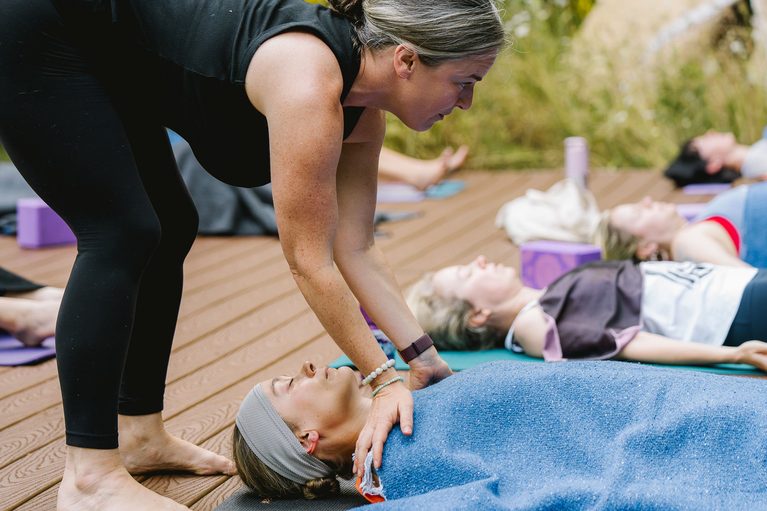
If someone starts snoring loudly enough to pull the room out, I get up and wake her. Gently, and this part is craft. I intentionally share my “wake up” protocol with my students while we’re preparing. This removes any uncertainty and reduces the chance that they will startle awake.
Kneel down beside her rather than standing over her. Make contact before sound — a light tug on her mat, a gentle hand on the top of her foot or on her shoulder, enough pressure that she registers it before she surfaces. Give it a second. Most people shift their breathing and come back up on their own without ever fully waking, and that’s the ideal outcome. I honestly never use words to bring students up from sleep, but if you do, keep them quiet and close and undirected — no name, nothing the rest of the room can hear.
Then go back to your seat and keep going in exactly the same voice. The room reads your response, not the snoring. If you handle it as unremarkable, it stays unremarkable.
And never, ever say anything to her about it afterward in front of anyone else.
When half the room goes under every single time
That’s a design question, not a discipline question, and no amount of instruction fixes it.
- Time of day. Mid-afternoon and post-dinner are the hardest slots to stay conscious in. Late morning is the easiest.
- What came before. Long hot vinyasa straight into nidra is a sleep protocol.
- Temperature and light. Warm and fully dark is a bedroom. Cool with a little low light keeps a thread of alertness alive.
- Position. Fully flat goes deepest. A bolster under the knees and a folded blanket under the head supports her without laying her out. Reclined or seated is an option for anyone who wants it.
- How tired the room genuinely is. Retreat, day two, after a hike? They’re going to sleep. Let them.
Change the conditions. Leave the instruction alone.

Want a script to try this on?
My nature-inspired yoga nidra script is free — printable PDF plus the full audio. It follows the Bihar School structure through the koshas with a journey instead of the archetypal images, and it’s the framework I teach from and train teachers on.
What changes when you stop policing it
The language your students use changes first.
Right now, in most rooms, women come up and apologize. I think I fell asleep, sorry. That apology is learned — she picked it up from a teacher who made sleep into a failure, and she’s carrying it into a practice designed to give her permission.
Take the failure condition out and you start hearing the other report instead. That she lost time. That she isn’t sure whether she was completely out or not. That something surfaced she wasn’t expecting. That in-between report is the practice doing precisely what it’s built to do, and it shows up far more often in rooms where nobody is “working at it.”
Your job is to build a room safe enough that her body will let go, and then to get out of the way of whatever it does next. Some days that’s conscious rest. Some days it’s the first real sleep she’s had in a month.
Both of those are worth it.
Next in this series: If You’re Teaching Yoga Nidra, Stop Calling It Nidra — on the stages most of us skip, and what’s left when you do.
Where to go next
- The science on why nidra works: The benefits of yoga nidra →
- The full script: Yoga nidra script inspired by nature (free PDF + audio) →
- Nidra for intention work: Yoga nidra for manifestation →
Learn to teach nidra properly
Framing, pacing, sankalpa work, and what to actually do when a room won’t settle — that’s the yoga nidra module of my 200-hour teacher training for women.
Frequently asked questions
Is it bad to fall asleep during yoga nidra?
No. It usually means two things, and both are good. Your body needed the rest, and your nervous system came down far enough to take it. Elevated arousal reliably blocks sleep onset, so sleep arriving is evidence that arousal fell away. Reaching that state in an unfamiliar room among people you barely know is harder than doing it at home, which makes it a sign the setting worked.
Does yoga nidra still work if you fall asleep?
Partly. The rest itself is real and your body takes it either way. What you miss is the conscious part, which is where the intention work happens and where you practise observing sensation without reacting to it. If you sleep through most practices you’re likely carrying a genuine sleep debt, and the awareness tends to return once that’s paid down. Treat the sleep as the practice doing something useful rather than as a session wasted.
How do I stop falling asleep during yoga nidra?
Practice earlier in the day, keep the room cool rather than warm, use a bolster under the knees and a folded blanket under the head instead of lying completely flat, and consider a reclined or seated position. Avoid practising straight after a vigorous class. If you fall asleep every time, you’re likely carrying a genuine sleep debt, and the awareness tends to return once that’s addressed.
Why do I twitch or jerk during yoga nidra?
Those are hypnic jerks, the involuntary muscle contractions that commonly occur as a body crosses from waking into sleep. They are harmless and most people experience them. In yoga nidra they are useful information rather than a problem: a jerk means you reached the threshold the practice is aiming at. Nothing needs to be done about them. Let the body settle and carry on.
Is one hour of yoga nidra equal to four hours of sleep?
No, and no research establishes that ratio. The claim circulates widely in yoga marketing but no study supports it. Yoga nidra does produce real physiological change and many people feel deeply rested afterwards, but it isn’t a replacement for sleeping and should not be described as one.
Should you tell students to stay awake during yoga nidra?
Say it once while explaining the practice, and optionally once more just before beginning. Don’t repeat it throughout. Yoga nidra depends on the release of effort, and asking a student to try harder to stay awake asks for vigilance, which is arousal. Repeated reminders also interrupt the students who were settling, while doing nothing at all for the ones already asleep.
Does the yoga nidra tradition say not to sleep?
Yes. In the Bihar School method taught by Swami Satyananda, yoga nidra is explicitly distinguished from sleep, and the instruction not to sleep appears in traditional scripts. The awareness is where the benefit of the practice lives. The tradition frames this once rather than repeating it, and it doesn’t treat a sleeping student as having failed.
Why do so many students fall asleep in yoga nidra?
Most are carrying a real sleep debt, and the practice creates the first conditions in which their body is willing to collect it. Setting matters too. Mid-afternoon and post-dinner slots, a warm dark room, lying fully flat, and a vigorous class immediately beforehand all make sleep more likely. Adjusting these conditions works far better than repeating an instruction.
What should a teacher do if a student snores during yoga nidra?
If the snoring is pulling the room out, wake her gently. Kneel beside her rather than standing over her, make light physical contact at the shoulder or foot before using any sound, and give her a moment to shift her breathing on her own. Keep any words quiet and undirected, then return to your seat and continue in the same voice. The room takes its cue from the teacher.
Is yoga nidra the same as sleep?
No. Yoga nidra guides you to the threshold between waking and sleeping and keeps a thread of awareness there, which is why it’s sometimes called conscious sleep or yogic sleep. Ordinary sleep involves losing that awareness. Most practitioners cross back and forth over the threshold several times in a single practice.
Why is it harder to sleep in an unfamiliar place?
Researchers call this the first-night effect. A 2016 study by Tamaki and colleagues found that in unfamiliar environments one brain hemisphere stays measurably more vigilant during deep sleep, acting as a kind of night watch. The effect runs automatically on novelty rather than on how anxious a person reports feeling, and it fades once a place becomes familiar. It’s why the first night of a retreat is often the hardest and the third is easier.
References
- Riemann D, Spiegelhalder K, Feige B, Voderholzer U, Berger M, Perlis M, Nissen C. “The hyperarousal model of insomnia: a review of the concept and its evidence.” Sleep Medicine Reviews 14(1):19–31, 2010. DOI: 10.1016/j.smrv.2009.04.002
- Dressle RJ, Riemann D. “Hyperarousal in insomnia disorder: current evidence and potential mechanisms.” Journal of Sleep Research, 2023. DOI: 10.1111/jsr.13928
- Tamaki M, Bang JW, Watanabe T, Sasaki Y. “Night watch in one brain hemisphere during sleep associated with the first-night effect in humans.” Current Biology 26(9):1190–1194, 2016. DOI: 10.1016/j.cub.2016.02.063
- Morgenthaler T, Kramer M, Alessi C, et al. “Practice parameters for the psychological and behavioral treatment of insomnia: an update. An American Academy of Sleep Medicine report.” Sleep 29(11):1415–1419, 2006.
- Ascher LM, Efran JS. “Use of paradoxical intention in a behavioral program for sleep onset insomnia.” Journal of Consulting and Clinical Psychology 46(3):547–550, 1978.
- Espie CA, Broomfield NM, MacMahon KMA, Macphee LM, Taylor LM. “The attention–intention–effort pathway in the development of psychophysiologic insomnia: a theoretical review.” Sleep Medicine Reviews 10(4):215–245, 2006. DOI: 10.1016/j.smrv.2006.03.002
About the Author
Autumn Adams
E-RYT, YACEP, Founder of Ambuja Yoga
Autumn Adams (E-RYT 500, YACEP) is the founder of Ambuja Yoga, where she's led women's yoga retreats since 2014 — 40+ retreats and 700+ women across Oregon, North Carolina, Sedona, Patagonia, Greece, Mallorca, and Thailand. Her work has been featured in Insider, Shape, Zappos, Asia Spa, Direct Holiday, and Bend Nest, and she's the author of The Little Book of Mudra Meditations.
You Might Also Enjoy
Dharana vs Dhyana: The Difference Between Concentration and Meditation
If you’ve ever sat down to “meditate,” lasted about forty seconds before your brain wandered…

The Yoga Philosophy Books That Changed How I Practice
The best yoga philosophy books don’t read like textbooks. They read like stories, and the…
If You’re Teaching Yoga Nidra, Stop Doing This
There’s one note I give yoga teachers more than any other when it comes to…