
Yoga Nidra for Manifestation: How Deep Rest Helps You Reconnect With What You Actually Want
13 years · 40+ retreats · 700+ women



Here’s a question that stops a lot of women cold: what do you actually want?
Not what your family needs. Not what’s on the list. Not the next thing you’re supposed to handle. What do you want — for your days, your body, your one life?
If your mind went quiet and a little panicky just now, you’re in good company. Most of us have been so busy meeting everyone else’s needs for so long that our own desires have gone faint. Not gone. Just faint. Buried under the noise.
And this is the part manifestation teachers almost never say out loud: you cannot manifest what you can’t feel. Manifestation doesn’t start with a vision board. It starts with desire — with actually knowing what you want, clearly enough to move toward it. And you can’t hear your own desire while your nervous system is roaring.
That’s exactly where yoga nidra comes in.
What Is Yoga Nidra?
Yoga nidra is a guided practice of deep, conscious rest where you lie down, follow a voice, and settle into the doorway between waking and sleep without falling asleep. It’s sometimes called “yogic sleep,” and the research world calls a version of it NSDR: non-sleep deep rest.
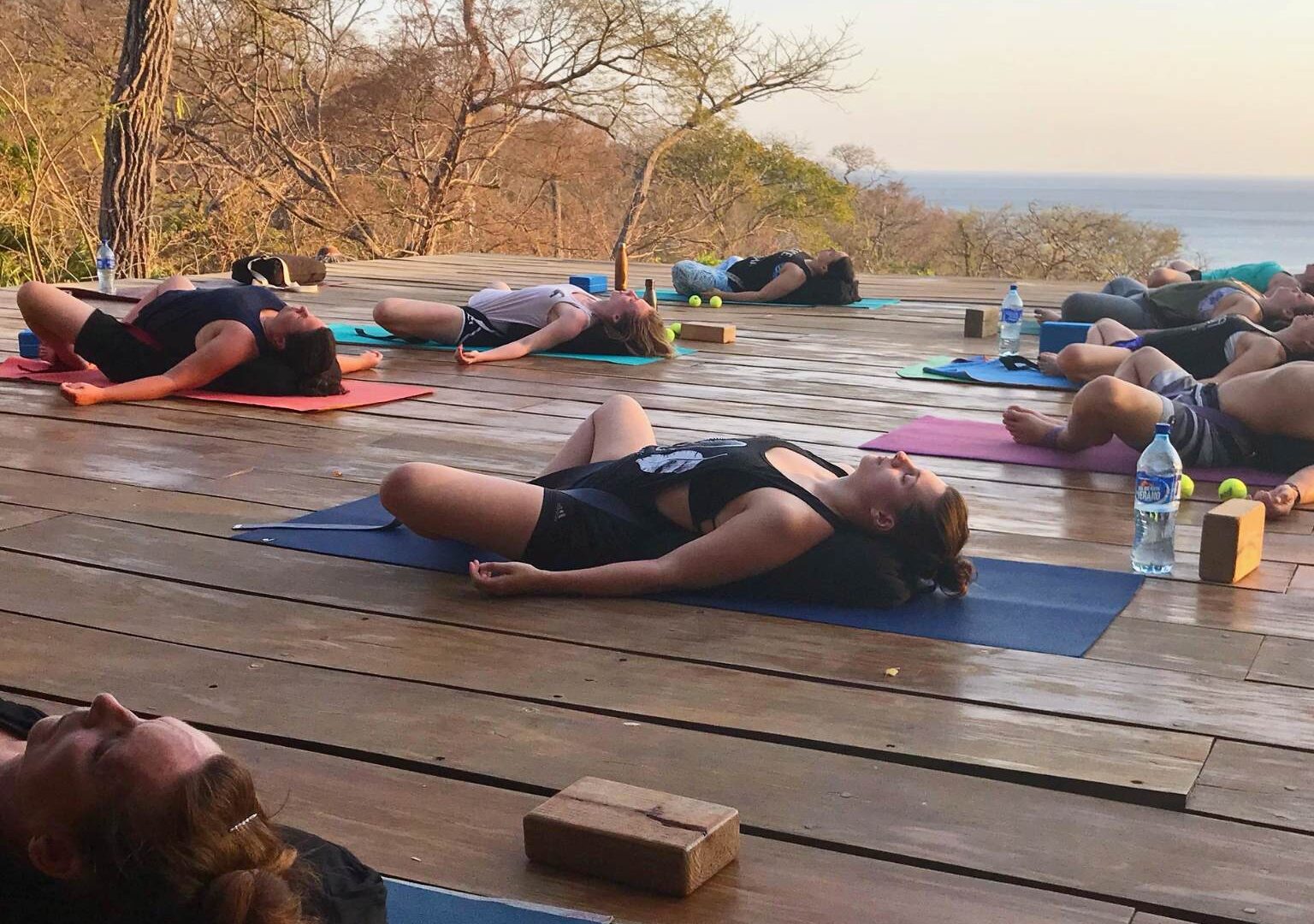
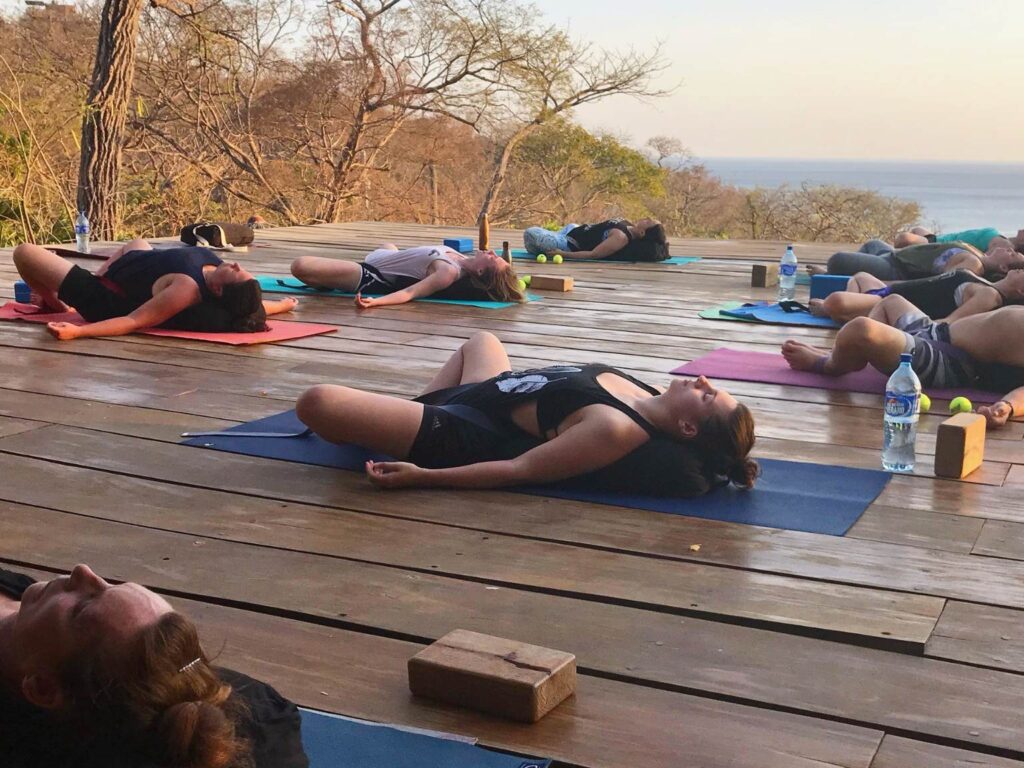
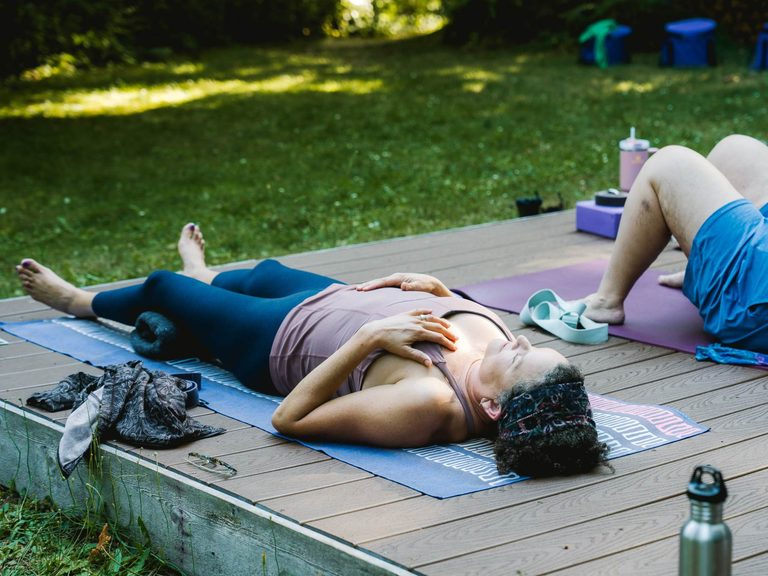
You’re not doing anything. You’re not clearing your mind or fixing yourself. You’re being guided through your body and breath while staying just barely awake — ten to forty minutes, lying down, under a blanket. It asks nothing of you. Which, for a woman who is asked for everything all day, is the entire point.
Why Can’t I Feel What I Want Anymore?
Because desire is quiet, and your nervous system is loud. When you’re running on empty — over-caffeinated, under-slept, bracing through the day — your brain stays in survival mode, scanning for the next threat and the next task. In that state there’s simply no bandwidth left to feel something as subtle as what would actually light me up.
Desire needs safety and space to surface. It’s not that you’ve stopped wanting things. It’s that wanting requires a nervous system calm enough to feel past the noise — and yours hasn’t had a quiet moment in a long time. Yoga nidra gives it one.
Doesn’t Yoga Teach Us to Let Go of Desire?
Not the way most people assume. Classical yoga philosophy actually honors desire — it names four kinds of it worth pursuing, called the Purusharthas, or the four aims of a whole life. Far from telling you to want less, the tradition says a meaningful life moves toward all four:
- Dharma — your purpose. The desire to become who you’re here to be, and to do the work that’s yours to do.
- Artha — your means. The desire for the resources, security, health, and stability that let you actually live your purpose. (Yes — wanting money and a home that supports you is a legitimate spiritual aim.)
- Kama — your pleasure. The desire for joy, beauty, delight, connection, and the simple experience of being alive in a body. Not a guilty afterthought. An aim.
- Moksha — your freedom. The desire to feel unburdened and spacious — free from the constant weight of everyone else’s needs.
If you’ve ever felt quietly guilty for wanting more comfort, more pleasure, or more freedom, this is your permission slip from a 2,000-year-old tradition: those wants aren’t unspiritual. They’re the point. Teacher Rod Stryker built an entire modern practice around exactly this — his book The Four Desires uses yoga nidra and sankalpa to help people clarify and move toward these very aims.
Which is what makes yoga nidra the natural home for this work. It’s not about transcending your desire. It’s about getting quiet enough to hear which of the four is calling you right now.
What Actually Happens in Your Brain During Yoga Nidra?
Your brain shifts out of its busy, alert beta-wave state and slows into alpha and then theta waves — the same receptive rhythm your brain makes right before you fall asleep, when the mental gatekeeping goes quiet and the deeper parts of you get a word in.
This is measurable, not poetic. In a well-known 2002 PET study published in Cognitive Brain Research, researchers scanned experienced practitioners during yoga nidra and found a roughly 65% increase in dopamine released in a reward-and-motivation region of the brain (the ventral striatum), correlated with rising theta activity. Dopamine isn’t only the “pleasure” chemical — it’s the chemistry of wanting, of anticipation, of what your brain marks as worth pursuing.
Sit with that for a second. In yoga nidra you get a calm body, the brain’s most receptive rhythm, and a surge in the exact neurochemistry of desire. It’s almost the perfect physiological setup for reconnecting with what you want.
How Does Yoga Nidra Help With Manifestation?
Yoga nidra helps you manifest by quieting the noise so you can feel your desire, then giving that desire to your brain as a clear target to move toward. Manifestation isn’t magic — it’s clarity plus a regulated nervous system plus neuroplasticity plus aligned action, over time. Yoga nidra sets up the first three.
It calms the nervous system so desire can surface. Yoga nidra activates the parasympathetic (“rest and digest”) side of your nervous system — heart rate drops, cortisol comes down. Only from that settled place can you feel the quiet pull of what you actually want, instead of just reacting to what’s urgent.
It opens the window where new wanting can take root. Neuroplasticity is your brain’s ability to form new patterns. Much of that rewiring happens during deep rest, not effort — and the theta-rich state of yoga nidra is one of the most receptive windows you have. It’s where a new desire can move from “I could never” to “maybe I actually want that.”
It sharpens what your brain goes looking for. Once you name a desire clearly, your reticular activating system (RAS) — the filter that decides what reaches your attention — starts flagging the people, resources, and openings that match it. It’s why you notice your car’s model everywhere the week after you buy it. Give the filter a clear desire, and it quietly starts hunting for it.
Then you act on what shows up. Desire without aligned action is just longing. Yoga nidra reconnects you to the wanting and primes the brain to notice the way forward — the next real step is yours to take.
What Is a Sankalpa — and How Is It Different From Wishing?
A sankalpa is a short, present-tense intention you plant during yoga nidra — your desire, distilled into one clear sentence and spoken as if it’s already true. It’s different from wishing because you set it in the receptive theta state, where your mind can receive it instead of instantly arguing it down.
In your busy daytime brain, you think I want to feel alive again and a voice fires back must be nice, no time for that. In the yoga nidra state that critical voice softens, and the desire gets to land. A good sankalpa is short, positive, and present-tense: not “I want to stop feeling numb” but “I am alive and awake to my life.” Not “I hope I’m worthy of more” but “I am worthy of a life that feels good.” You’re not lying to yourself — you’re letting yourself want something clearly, in the one state open enough to believe it’s possible.
If you’re not sure what to name, let the four desires be your starting point. Is it dharma calling — a pull toward purpose or work that’s actually yours? Artha — the security and resources to breathe? Kama — more pleasure, more joy, more aliveness in your days? Or moksha — freedom, space, room that belongs to no one but you? You don’t have to name all four. Just the one that’s loudest right now.
How Do You Practice Yoga Nidra for Manifestation?
You practice by resting into a guided recording and planting one clear desire as your sankalpa at the start and end. No experience, flexibility, or special setup required. The simple version:
Before you begin, ask yourself the honest question — what do I actually want right now? — and let one true answer rise. Lie down somewhere warm and quiet, under a blanket, and press play on a guided yoga nidra (twenty minutes is plenty). As it starts, name your desire once as a present-tense sankalpa. Then let the voice carry you and stop trying. You’ll drift and float back — that’s the state. At the end, name your desire one more time. Then get up and take one small step toward it.
Feel the want. Name it clearly. Take the aligned action. Repeat it enough that it becomes a pattern. That’s manifestation with the science attached — and with your own desire back at the center of it.
Frequently Asked Questions
Is yoga nidra actually backed by science? Yes. Research on yoga nidra and non-sleep deep rest shows it shifts the brain into theta-wave states, activates the parasympathetic nervous system, lowers cortisol, and in one PET study was associated with a roughly 65% increase in dopamine. These are measured physiological effects, not just a feeling of calm.
How does yoga nidra help you manifest what you want? Yoga nidra helps you manifest by calming your nervous system enough to actually feel your desire, opening the brain’s receptive state where new wanting can take root, and helping you hold that desire as a clear intention. You still take aligned action — but yoga nidra reconnects you to what you’re moving toward in the first place.
What if I don’t even know what I want anymore? That’s incredibly common, and it’s usually a sign of depletion, not failure. Desire is quiet and needs a calm nervous system to surface. Yoga nidra creates exactly that quiet — many women find that once the noise drops, a clear want they’d forgotten about comes back into focus.
What are the four desires in yoga? The four desires are the Purusharthas — yoga’s four aims of a whole life: dharma (purpose), artha (the means and security to live it), kama (pleasure and joy), and moksha (freedom). Rather than teaching you to give up desire, this framework treats these wants as legitimate and worth moving toward. They make a useful starting point for choosing a sankalpa.
What’s the difference between yoga nidra and meditation? In most meditation you sit upright and practice focusing or observing your mind. In yoga nidra you lie down and are guided into a state between waking and sleep, doing effectively nothing. Yoga nidra is often easier for beginners because there’s no “doing it right.” Learn more about the differences between yoga nidra and meditation here.
What is a sankalpa? A sankalpa is a short, present-tense intention — your desire in one clear sentence, like “I am alive and awake to my life” — that you plant during yoga nidra, when your mind is receptive enough for it to take root.
Do I need experience to try yoga nidra? No. Yoga nidra requires no yoga experience, no flexibility, and no ability to quiet your mind. You lie down and listen. It’s one of the most beginner-friendly practices there is.
How long should a yoga nidra practice be? Ten to forty minutes. Even a short session shifts your nervous system. Twenty minutes is a good starting point, midday or before bed.
How often should I practice for it to work? Consistency matters more than length. A short daily or near-daily practice, returning to the same clear desire, gives your brain the repetition it needs to form a new pattern — the way any real change happens: a little, often, over time.
A gentle invitation
If reading this stirred up a want you’ve been ignoring — even a small one — don’t rush past it. That flicker is information.
You are allowed to want things. A life with more ease in it. More laughter. More of whatever quietly lights you up. Wanting more isn’t selfish and it isn’t too late — it’s the most honest starting point there is. Rest isn’t the destination here. Desire is. Rest is just how you get quiet enough to feel it again.
Try this tonight: Twenty minutes of yoga nidra, one honest desire named as your sankalpa, before you fall asleep. Notice what your attention starts catching tomorrow. Here’s one of mine.
And if you’re craving the deeper version — a few days to truly rest, get quiet enough to hear what you actually want, and let yourself want it out loud alongside women who get it — our next retreat is Rooted & Wild near Asheville, NC this fall. Come as you are.
The Research
Kjaer TW, et al. “Increased dopamine tone during meditation-induced change of consciousness.” Cognitive Brain Research, 2002. PubMed
About the Author
Autumn Adams
E-RYT, YACEP, Founder of Ambuja Yoga
Autumn Adams (E-RYT 500, YACEP) is the founder of Ambuja Yoga, where she's led women's yoga retreats since 2014 — 40+ retreats and 700+ women across Oregon, North Carolina, Sedona, Patagonia, Greece, Mallorca, and Thailand. Her work has been featured in Insider, Shape, Zappos, Asia Spa, Direct Holiday, and Bend Nest, and she's the author of The Little Book of Mudra Meditations.
You Might Also Enjoy
Dharana vs Dhyana: The Difference Between Concentration and Meditation
If you’ve ever sat down to “meditate,” lasted about forty seconds before your brain wandered…
If You’re Teaching Yoga Nidra, Stop Doing This
There’s one note I give yoga teachers more than any other when it comes to…
If You’re Teaching Yoga Nidra, Stop Policing Sleep
Full disclosure, I trained in a Bihar-inspired lineage, so I do ask my students to…