
How to Teach Chair Pose: Alignment, Teahing Cues, and Variations
13 years · 40+ retreats · 700+ women

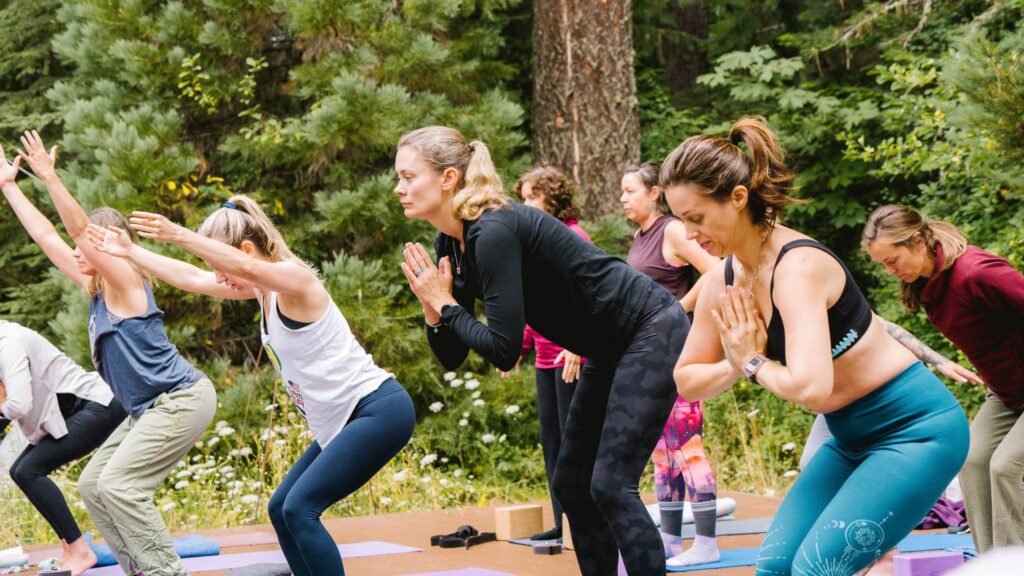
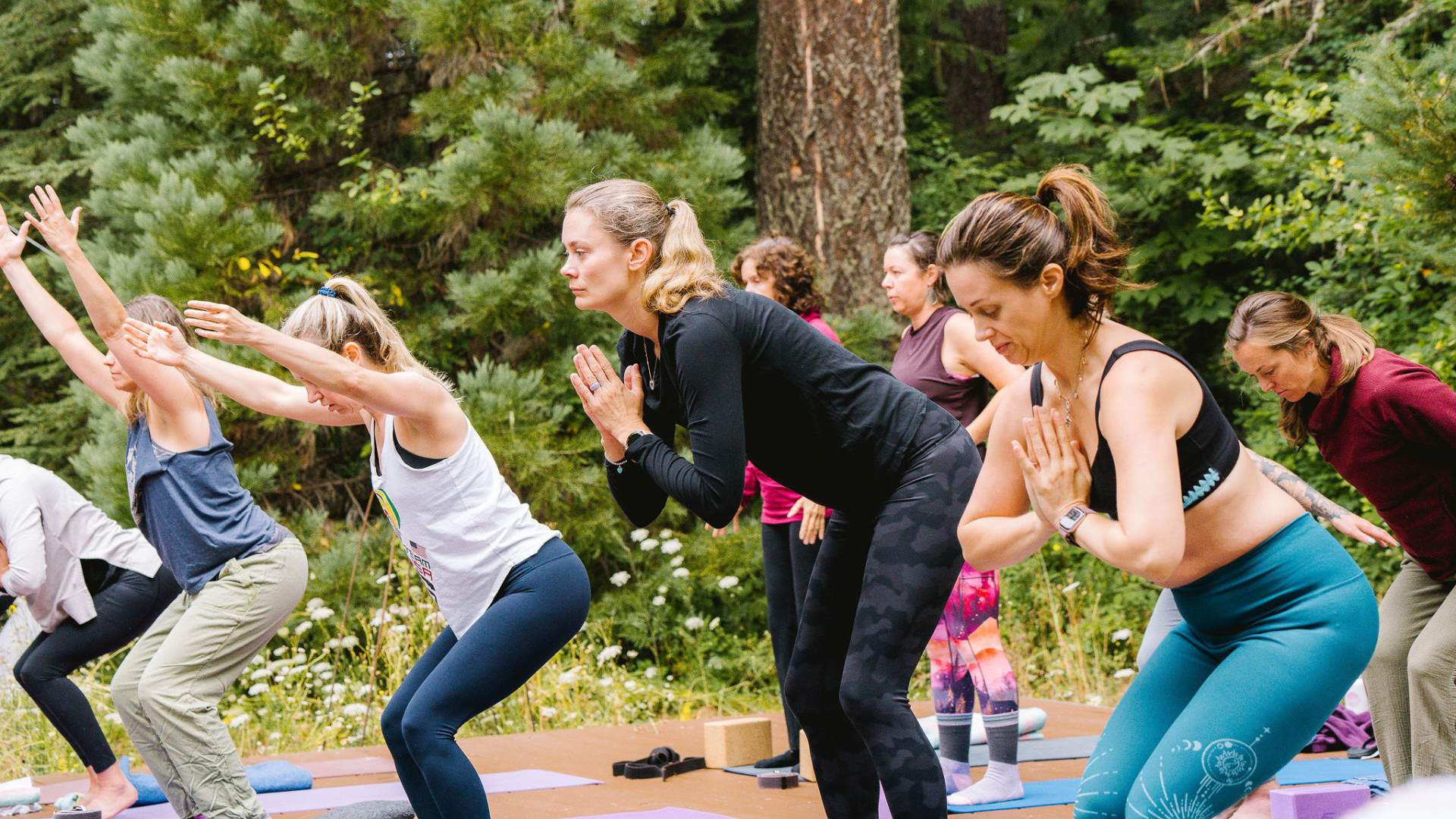
Chair pose shows up in almost every vinyasa and ashtanga class you’ll ever take. It looks simple on paper — bend the knees, reach the arms, sit back into an invisible chair — and then you hold it for five breaths and your quads start talking.
This is a full teaching guide to chair pose, or utkatasana in Sanskrit. Where the name comes from and what it actually means. How to cue it from the ground up. What usually goes wrong and how to fix it in real time. Variations, modifications, and the honest version of what the pose is doing in the body.
It’s written for two people: the teacher who wants better cues, and the student who wants to understand what she’s being asked to do and why.
Table of Contents
- What is chair pose?
- What does utkatasana actually mean?
- Where did chair pose come from?
- Is there a story behind chair pose?
- Yoga cues and alignment tips for teaching chair pose
- Should your knees go past your toes?
- Common chair pose mistakes and how to fix them
- Variations of chair pose
- How to modify chair pose for different bodies
- Benefits of chair pose
- FAQ
What Is Chair Pose?
Chair pose is a standing yoga posture where you bend your knees, sit your hips back and down, and reach your arms overhead — as if lowering yourself into a chair that isn’t there. It’s called utkatasana in Sanskrit, pronounced oot-kah-TAH-suh-nuh.
It builds strength and stability in the legs and core, creates heat in the body, and asks for focus and balance in a way that a lot of standing poses don’t. Most of the work is happening in the quadriceps, glutes, calves, and ankles, with the deep core and back muscles working to keep the spine long while the hips travel back.
It’s also one of the most-cued and least-explained poses in a general class. Which is exactly why it’s worth slowing down on.
What Does Utkatasana Actually Mean?
Utkatasana does not mean “chair pose.” The Sanskrit word utkata means fierce, powerful, proud, intense, immense, or difficult — so the more literal translation is fierce pose or powerful pose. “Chair” is a modern English nickname that describes what the shape looks like, not what the name says.
You’ll hear all of these in different rooms:
- Chair pose — the common English name
- Fierce pose or powerful pose — closer to the Sanskrit
- Awkward pose — what it’s called in the Bikram sequence
- Utkatasana — Sanskrit, from utkata (fierce, powerful) + asana (seat or posture)
That same root shows up in the pose next door. Utkata konasana — usually taught in English as goddess pose — is fierce angle pose. Same fierceness, wider stance. If you have ever wondered why goddess pose and chair pose feel like cousins, that’s why: they’re named for the same quality, not the same shape.
This is worth saying out loud in class, because the English name quietly changes what a student thinks she’s doing. “Sit down in a chair” is a passive instruction. “Hold a fierce, powerful shape” is not. The Sanskrit is asking for something the nickname doesn’t.
Where Did Chair Pose Come From?
The standing version of chair pose we practice today is relatively modern, but the name is centuries old — and it originally described a squat, not a standing pose. The lineage runs roughly like this:
15th century — Hatha Yoga Pradipika. The earliest clear textual mention of utkatasana isn’t in a list of postures at all. It appears in the chapter on cleansing practices, in the instructions for basti — a yogic colon-cleansing technique performed while squatting in navel-deep water. Utkatasana here simply names the squat you hold while you do it. Not glamorous. Very useful for keeping our stories about “ancient poses” honest.
17th century — Gheranda Samhita. Utkatasana appears as one of the 32 asanas taught in the text’s second chapter, described as balancing on the big toes with the heels lifted and the seat resting back onto the heels. Still a squat — a toe-balancing one.
19th century — Sritattvanidhi. This illustrated Mysore manuscript describes utkatasana with the soles of the feet on the ground and the knees drawn up toward the ears, and names it the haughty. A deep squat again, and again named for attitude rather than furniture.
20th century — Krishnamacharya and the Mysore Palace. The upright, standing, arms-overhead chair pose that shows up in modern vinyasa and ashtanga is generally traced to Krishnamacharya’s teaching in Mysore, where the older squatting utkatasana was reworked into the standing form we inherited.
So when someone tells you chair pose is a 500-year-old posture, the honest answer is: the name is at least that old, and it used to mean something different. The shape in your class is closer to a hundred years old than a thousand. That doesn’t make it less valuable. It makes it a living tradition rather than a museum piece — which is a much more interesting thing to teach.
Is There a Story Behind Chair Pose?
No classical text assigns chair pose to a particular deity the way the warrior poses are tied to Virabhadra. What exists is a teaching story — one that connects utkatasana to the throne, and to the Ramayana.
The story goes like this. In the India where these texts were written, chairs were not ordinary household objects. Most people sat on the floor or the ground. Elevated seats were for royalty — thrones, raised so a king or queen could be seen, and could see. That act of seeing and being seen has its own name, darshan, and it’s central to how people related to both rulers and deities.
The Ramayana — the epic of Rama’s exile, his fourteen years away from home, and his eventual return to Ayodhya to be crowned — is, read a certain way, a story about a throne. Who sits in it. Who was denied it. What it costs to come back and claim it.
Worth knowing if you teach this: Hindu tradition classifies the Ramayana as itihāsa, which translates roughly as “so it happened.” It’s held as history, and it’s living scripture for a great many people practicing today. That’s a good reason to speak about it with the same care you’d want extended to anything you hold sacred.
Told alongside utkatasana, the frame lands: this is not an easy chair. It’s a throne. You are not sinking into it, you are holding yourself in it. And utkata — fierce, proud, powerful — is exactly the quality the story is about.
One honesty note: This connection is a teaching layer, not a textual origin. The old manuals that name utkatasana don’t mention Rama, and the pose they describe is a squat used for cleansing practices and seated work. The throne story came later, from teachers and writers finding meaning in the shape.
That’s not a reason to drop it. Yoga has always accumulated meaning this way. It’s a reason to say it accurately. “There’s a story teachers tell about this pose” is a completely different sentence from “this pose comes from the Ramayana,” and only one of them will survive a student who goes home and reads about it.
If you want to offer it in class, offer it as what it is:
“There’s an old idea that chairs in India were for royalty — that a chair meant a throne. Some teachers tell this pose that way: not sinking into a seat, but holding yourself in one. See what happens if you practice it like that for the next five breaths.”
Then let her decide what to do with it.
Yoga Cues and Alignment Tips for Teaching Chair Pose
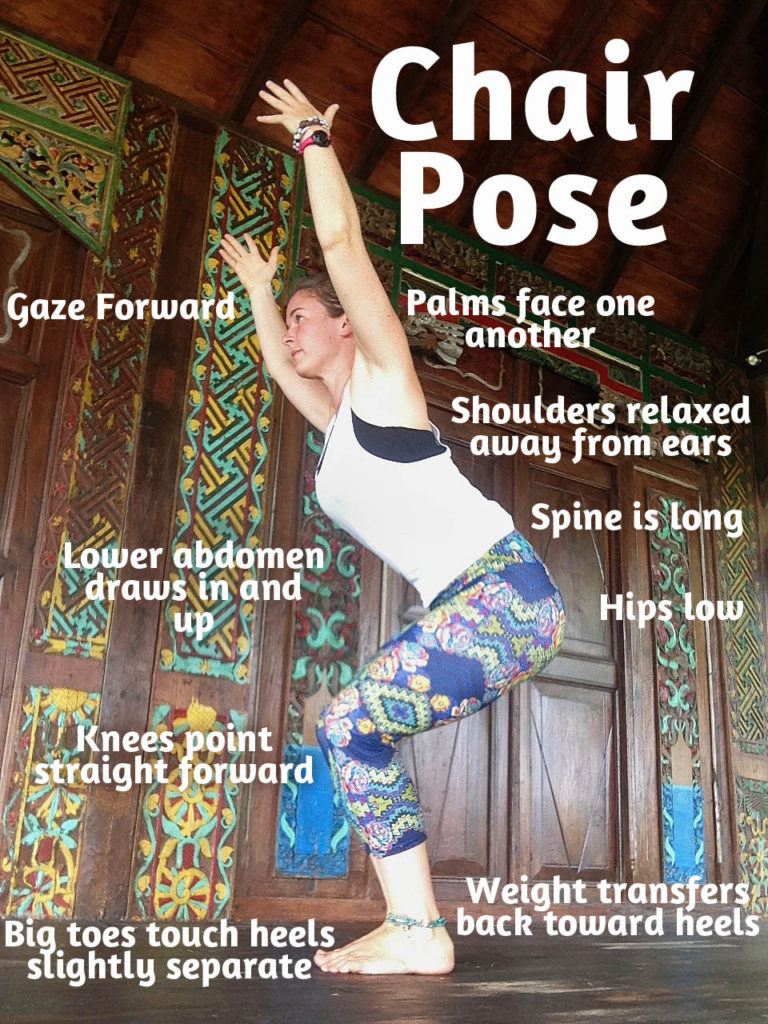
Teach chair pose from the ground up — feet first, then knees, then hips, then spine, then arms. Just as you would build a house starting with the foundation, it’s important to build a steady posture from its base. Students feel the difference immediately, because the pose stops being a shape they’re holding and becomes a structure that holds them.
Here’s the sequence, in cueing order:
- Stand with feet together. Big toes touching, heels slightly apart.
- Knees point over the second toes. This is the alignment that protects the knee — the joint tracking in the direction the foot is pointing.
- Weight distributed back toward the heels. She should be able to lift her toes, or at least feel that she could.
- Sit the hips low. Send the hips back and down, the way you would toward a real seat behind you.
- Lengthen the spine by drawing the lower abdomen in and up. This is what keeps the low back from collapsing as the hips drop.
- Arms reach overhead with palms facing one another. Biceps beside the ears, if the shoulders allow.
- Shoulders soften away from the ears.
- Gaze straight ahead — healthiest for the neck. No craning up to look at the hands.
A note on the arms. If chair pose creates too much tension and stress in your student’s shoulders, suggest she take the hands slightly wider than the shoulders, or “goal post” the arms — elbows bent, upper arms out to the sides. This is not a lesser version. For a lot of shoulders, it’s the version that lets the legs actually do the work instead of the whole pose getting hijacked by the upper body.
A note on feet together. Feet together is the classic ashtanga expression, and it’s harder — narrower base, more balance demand, more adductor work. Feet hip-width apart is not a beginner’s compromise. It’s a different pose with a different job: more stable, more accessible for wider hips, and easier to load the glutes. Offer both, and say what each one is for.
Should Your Knees Go Past Your Toes?
Probably yes, at least a little — and the “knees must never pass the toes” rule is more rigid than the evidence supports. In a small 2003 study in the Journal of Strength and Conditioning Research, researchers compared barbell squats with knee travel restricted by a physical barrier against squats with no restriction. Blocking the knees from moving forward reduced torque at the knee — and dramatically increased torque at the hip, along with more forward lean of the trunk. The authors concluded that appropriate loading may actually require the knees to move slightly past the toes.
Hold that finding loosely. It’s seven trained men doing loaded barbell squats, not women holding an unloaded yoga pose for five breaths. But the mechanical principle transfers: when you forbid one joint from moving, the load doesn’t vanish. It relocates. Usually to the hips and low back.
What this means for how you cue chair pose:
- Keep cueing weight back toward the heels. That’s still the right instruction — it loads the posterior chain and keeps her from tipping forward onto the toes.
- Stop policing the knee line. A knee that travels slightly past the toes in a bodyweight pose is not an injury waiting to happen.
- Keep cueing knee tracking. Direction matters far more than distance. A knee collapsing inward toward the midline is the alignment worth correcting; a knee moving forward over the foot generally isn’t.
- Watch the ankles. Limited ankle dorsiflexion is often what’s driving a student to lean forward or lift her heels. That’s an ankle conversation, not a knee one.
Common Chair Pose Mistakes and How to Fix Them
Most chair pose problems come from the pose migrating upward — out of the legs, where the work belongs, and into the low back, shoulders, or neck. Here’s what you’ll actually see in a room, and what to say about it.
| What you see | What’s happening | What to cue |
|---|---|---|
| Ribs flaring, big arch in the low back | The arms went overhead but the front body didn’t stay connected; the back is doing the shoulders’ job | “Draw the lower belly in and up. Let the front ribs knit toward each other.” |
| Knees collapsing toward each other | Weak or unengaged glutes and outer hips | “Press the outer edges of your feet down. Widen your knees toward your pinky toes.” |
| Weight tipping into the toes, heels lifting | Limited ankle mobility, or she’s sitting down instead of back | “Send your hips back like the chair is behind you. See if you can lift your toes.” |
| Shoulders up around the ears | Reaching from the traps instead of lengthening from the side body | “Reach up through your fingers and let the tops of your shoulders melt down.” |
| Chin lifted, gaze at the hands | Habit — she’s following her arms | “Eyes forward. Let the back of your neck stay long.” |
| Holding the breath | The pose got hard and she braced | “Nothing about this pose requires you to hold your breath. Let it be loud if it wants to be.” |
That last one is worth its own beat. Chair pose is where a lot of women meet the moment they decide whether to grip or to breathe — and where a teacher can offer a genuinely useful choice: come up a little higher, and keep breathing. Depth is not the point. Staying present in effort is.
Teaching this well takes more than a good cue list.
Knowing why a cue works, when to drop it, and how to read a body that doesn’t match the textbook is the difference between leading a class and teaching one. That’s the core of Ambuja Yoga’s 200-hour teacher training, Inner Alchemy: Root & Radiance — a women-centered training built around anatomy, nervous system science, and the real bodies in your room.
Variations of Chair Pose
Chair pose adapts easily — you can twist it, lift the heels, bind the arms, narrow or widen the stance, or take it to a wall. Each variation changes the job of the pose, so choose based on what you want a student to feel.
- Revolved chair (parivrtta utkatasana). Add a twist. Several arm options work: hands at heart center in prayer, or arms spread wide. Those two are my favorites. Cue the twist from the ribs rather than the arms, and keep the knees level with each other — the knee opposite of the direction you’re twisting will want to slide forward.
- Heels lifted. Press up high onto the balls of the feet and lift the heels. Adds a real balance and calf demand, and quickly shows a student how much she’s been relying on her heels for stability.
- Hands bound behind the hips. This option opens the shoulders and chest. Interlace behind the back, straighten the arms, draw the knuckles down and away. Good counter to a day at a desk.
- Feet hip-width with a block between the inner thighs. This version of utkatasana helps engage and strengthen the inner thighs (adductors). Squeeze the block and notice how the pelvic floor and deep core come online with it.
- Palms touching overhead. Bring the palms of the hands together above the head. A small change that asks more of the shoulders and upper back.
- Ardha utkatasana (half chair). Bend the knees closer to a right angle so the thighs come nearer to parallel with the floor and the torso inclines forward over them. This is the harder, more athletic expression — not a half-effort version.
- Chair at the wall. Back against the wall, feet a step out, slide down. Removes the balance demand entirely so the legs can work without the fear of tipping. Excellent for beginners, for larger bodies, and for anyone rebuilding leg strength.
- Chair with an actual chair. Set a real chair behind her and let her touch down and lift off it. Best teaching tool there is for the “hips back, not down” cue.
- Chair with a block between the hands. Hold a block between the palms overhead and press in. Instantly recruits the upper back and stops the arms from splaying.
- One-legged chair (figure four / eka pada utkatasana). Ankle crossed over the opposite thigh, sit back. Big balance and hip demand — a strong option for students who want more.
- Utkata konasana (goddess pose). Not a chair pose variation exactly, but the same utkata root and a natural pairing. Wide stance, feet turned out, knees bent and tracking over the toes.
How to Modify Chair Pose for Different Bodies
Chair pose is highly modifiable, and the right modification depends on what’s limiting — knees, shoulders, ankles, low back, or joint stability. Some starting points:
- Sensitive knees. Reduce the depth. A shallow bend held with good tracking is more useful than a deep bend held with a collapsing knee. Feet hip-width often feels better than feet together.
- Shoulder limitation or overhead pain. Goal-post arms, hands wider than shoulders, or hands at heart center. Nothing about the leg work requires the arms overhead.
- Limited ankle dorsiflexion. A folded blanket or a low wedge under the heels. This is one of the fastest, most satisfying fixes in a yoga room — the trunk comes upright immediately.
- Low back discomfort. Come higher, and cue the lower belly in and up before the arms go overhead. Usually the arms are the culprit.
- Hypermobile students. Watch for the low back doing the work of the shoulders, and for a locked, hanging quality at the elbows. Cue muscular engagement before depth — hug the muscle to the bone, keep a soft elbow, and work at eighty to ninety percent of available range rather than the end of it. Hypermobile bodies tend to have poorer joint position sense, so she genuinely may not feel where the end of the range is.
- Pregnancy. Widen the stance for a stable base, reduce the depth, and skip the closed twist in revolved chair — take it open instead, with the hand reaching back rather than crossing the belly.
- Larger bodies. Feet hip-width or wider. The wall version is often more useful than the free-standing one, and there is no reason to treat it as a lesser expression.
- Perimenopause and beyond. Chair pose is load-bearing leg and hip work, which matters more as estrogen declines and bone and muscle loss accelerate. Longer warm-ups, and keep the strengthening in. This is not the season to take it out.
“She gives you options for how to get into a pose, and she commands the room in a very gentle way that you feel safe. She makes the room a place where you can practice in your own space and not worry about anyone else.” — Bridget Carroll, Rooted & Wild, Sedona
Benefits of Chair Pose
Chair pose builds lower-body and core strength, improves ankle and hip stability, and generates heat — those are its most defensible benefits. Specifically:
- Builds strength and stability in the lower body, including the hip flexors, quads, ankles, and calves
- Tones the muscles of the legs
- Strengthens the core muscles of the trunk
- Opens the chest and shoulders
- Loads the legs and hips in a weight-bearing way, which supports bone and muscle maintenance over time
- Creates heat, which is why it shows up early in vinyasa sequences
- Requires focus and balance, which is its own kind of practice
What tradition adds. Older and more traditional sources describe utkatasana as stimulating the heart, diaphragm, and abdominal organs, and associate it with the svadhisthana chakra and qualities of creativity and determination. These are worth knowing and worth teaching as tradition. They aren’t clinical claims, and it’s cleaner to say so — “in this tradition, this pose is associated with…” rather than “this pose stimulates your organs.”
Students trust a teacher who marks the difference between what’s measurable and what’s inherited. It costs nothing to be precise, and it buys a lot.
“I appreciated the pose modifications for beginners and for more advanced yogis.” — Stefanie D., Back to Nature, Oregon
Chair Pose FAQ
What does utkatasana mean? Utkatasana comes from the Sanskrit utkata, meaning fierce, powerful, proud, or intense, and asana, meaning seat or posture. A more literal translation is fierce pose or powerful pose. “Chair pose” is a modern English nickname based on the shape.
How do you pronounce utkatasana? Utkatasana is pronounced oot-kah-TAH-suh-nuh, with the emphasis on the third syllable.
Is chair pose the same as awkward pose? Yes and no. Awkward pose is the name used for utkatasana in the Bikram sequence, though the Bikram version is taught as a three-part series with different leg positions rather than the single standing shape used in vinyasa and ashtanga.
What muscles does chair pose work? Chair pose primarily works the quadriceps, glutes, hamstrings, calves, and ankle stabilizers, with the deep core and spinal muscles working to keep the torso long. The shoulders and upper back work to hold the arms overhead.
Should your knees go past your toes in chair pose? A small amount of forward knee travel is generally fine in an unloaded pose. Research on squats found that physically blocking the knees from moving forward reduced knee torque but sharply increased load at the hips and low back. Knee tracking direction matters more than knee travel distance — a knee collapsing inward is the alignment worth correcting.
How long should you hold chair pose? Five breaths is standard in vinyasa and ashtanga sequences, which usually works out to roughly thirty seconds. For strength-building purposes, longer holds of forty-five seconds to a minute are useful, as long as the student can keep breathing and maintain knee tracking.
Is chair pose safe for bad knees? Chair pose can often be adapted for sensitive knees by reducing the depth of the bend, taking the feet hip-width apart, and making sure the knees track over the second toes rather than collapsing inward. Anyone with a diagnosed knee condition or ongoing pain should check with a physical therapist or physician.
What are the best variations of chair pose? Common chair pose variations include revolved chair with a twist, chair with the heels lifted, chair with the hands bound behind the hips, chair with a block between the inner thighs, palms touching overhead, half chair with the thighs closer to parallel, and chair practiced against a wall for extra support.
About the Author
Autumn Adams is the founder of Ambuja Yoga and an E-RYT 500, YACEP-certified teacher based in Bend, Oregon. She has been leading women’s yoga retreats since 2014 — 13 years, 40+ retreats, and 700+ women across Oregon, North Carolina, Sedona, Patagonia, Mallorca, Greece, and Thailand. She is the author of The Little Book of Mudra Meditations and the host of The Aligned Yogi Podcast, and her work has been featured in Insider, Shape, Zappos, and Asia Spa. More about Autumn →
Practice This in a Room Full of Women
Chair pose is a good one to keep working on at home. It’s a different thing entirely to practice it somewhere with no rush attached — outside, in a body that finally got some sleep, with women who are also figuring out what they want the next chapter to feel like.
That’s what Ambuja Yoga retreats are for. Small groups, real food, actual nature, and yoga that meets the body you brought.
Not ready for that yet? Get on the email list for teaching notes, practice breakdowns like this one, and first word when new retreat dates open.
About the Author
Autumn Adams
E-RYT, YACEP, Founder of Ambuja Yoga
Autumn Adams (E-RYT 500, YACEP) is the founder of Ambuja Yoga, where she's led women's yoga retreats since 2014 — 40+ retreats and 700+ women across Oregon, North Carolina, Sedona, Patagonia, Greece, Mallorca, and Thailand. Her work has been featured in Insider, Shape, Zappos, Asia Spa, Direct Holiday, and Bend Nest, and she's the author of The Little Book of Mudra Meditations.
You Might Also Enjoy

The Yoga Philosophy Books That Changed How I Practice
The best yoga philosophy books don’t read like textbooks. They read like stories, and the…
If You’re Teaching Yoga Nidra, Stop Doing This
There’s one note I give yoga teachers more than any other when it comes to…
If You’re Teaching Yoga Nidra, Stop Policing Sleep
Full disclosure, I trained in a Bihar-inspired lineage, so I do ask my students to…