
The Yogi’s Guide to Yoga in Mallorca: Studios, Markets, Mountain Trails, and a Long Lunch
13 years · 40+ retreats · 700+ women


Everything I send my retreat guests when they ask what to do with their extra days on the island.
Table of Contents
- Is Mallorca good for yoga?
- The 5 best yoga studios in Mallorca (and the vibe of each)
- Where to practice outside
- The best hikes in the Serra de Tramuntana
- Mallorca’s markets, by day
- Where to buy natural fibers, ceramics, and things made on the island
- Herbolarios, salt, and the quieter kind of magic
- The not-so-yogi part: wine, long lunches, and swimming
- The Sóller train, and the one day trip worth the effort
- Events worth planning your trip around
- If you only have 48 hours
- Frequently asked questions
Mallorca surprises women who arrive expecting a beach island. And yes, there are MANY beautiful coves to swim in and beautiful beaches too, but…
What’s actually here is a mountain range — the Serra de Tramuntana, a UNESCO World Heritage site that runs the length of the northwest coast in terraces of dry-set stone built by hand over centuries. Olive trees that have been alive for a thousand years. Villages the color of honey. Water so clear it doesn’t look real in photos, which is why nobody believes your photos.
I’m bringing a group of women here because it’s beautiful, truly beautiful. The beauty of this place has a way of dropping you right into awe and wonder. Not in a woo way — in the way that a long lunch under a fig tree with people you like genuinely changes how you feel about your life. You don’t have to be depleted to deserve a trip like this. You can just want it.
So here’s my working list: the studios I’d send you to and what each one feels like, the hikes worth the early start, the markets, the shops selling things actually made on this island, and where to eat lunch for three hours. This comes from our community — not from a search result.

Is Mallorca good for yoga?
Yes. Mallorca has one of the most established yoga scenes in the Mediterranean, with dozens of studios concentrated in Palma, most classes taught in English, and a year-round culture of outdoor practice. Teachers from all over the world have relocated here over the last two decades, which means you can find vinyasa, yin, kundalini, ashtanga, nidra, and bowspring within a few streets of each other in Palma.
Practically: most Palma studios take drop-ins without a membership, and English is the default in the majority of classes. The heart of it is Santa Catalina — a former fishing quarter west of the old town, now full of small studios, vegetarian cafés, and independent shops. You can walk the whole neighborhood in twenty minutes.
The 5 best yoga studios in Mallorca (and the vibe of each)
1. Earth Yoga — the one to pick if you only take one class
Santa Catalina, Palma
One of the oldest and most established studios in Palma, and the easiest recommendation for a visitor. Vinyasa, yin, hatha, nidra, kundalini, prenatal, restorative, across two rooms and a deep bench of teachers from all over the world. Nearly everything is taught in English.
The vibe: Warm, eco-conscious, unfussy. Fair prices, friendly desk, no membership pressure. They also host kirtans, workshops, and masterclasses, so check the calendar — you might land on something good.
Best for: First class on the island. Also the best bet if you want to walk in without pre-booking.
2. Sadhana Works — the beautiful one
Downtown Palma
Tucked into a calm interior courtyard in the middle of the old town, which is exactly as lovely as it sounds. Hatha, gentle, vinyasa, kundalini, and bowspring.
The vibe: Quiet and architecturally gorgeous. The kind of space where you arrive early on purpose just to sit in the courtyard. Smaller and more contemplative than Earth Yoga.
Best for: A slow morning downtown, followed by coffee and the cathedral.
3. Yoga del Mar — the one by the sea
Portixol, a few minutes east of central Palma
Mallorca’s first yoga studio, right on the water in the old fishing village of Portixol. Indoor and outdoor practice with a sea view, run by two owners who greet people by name and hand out fresh iced tea afterward. English classes daily, mornings and evenings. They also do private and partner sessions, and you can add a massage after.
The vibe: Boho, beachy, personal. Small enough that you’ll be remembered on day two.
Best for: Practicing with the sound of water. Also the best studio to pair with a swim and a long breakfast on the promenade.
4. Ra Ma Institute Mallorca — for kundalini
Palma
The island’s home for kundalini yoga — breath, kriya, mantra, the full lineage — and welcoming whether you’ve done a hundred classes or none.
The vibe: Committed and a bit intense in the best sense. This is not a stretch-and-go studio. Come curious.
Best for: Anyone who wants a practice that’s more breath and sound than shape.
5. Surya Yoga, Alaró — the village one
Alaró, in the Tramuntana foothills, about 30 minutes from Palma
A small, cozy space in a village at the foot of the mountains, run by one teacher who people genuinely love. Worth building a day around: class, lunch in the village, then the climb toward Castell d’Alaró if your legs are willing.
The vibe: Local, unhurried, human-scale. The opposite of a destination studio.
Best for: The day you want to get out of Palma entirely.
Also worth knowing: there’s a real concentration of independent teachers on this island, many offering private sessions at your accommodation. If you’re staying somewhere rural with a group, a private class in the garden is often easier — and no more expensive — than driving into Palma.
Where to practice outside
Mallorca’s outdoor practice culture is largely private and seasonal rather than scheduled — so rather than hunting for a public outdoor class, do one of these:
Book a private beach or terrace session. Yoga del Mar and most independent teachers offer these. A sunrise practice on a terrace above the sea is the thing you’ll actually remember.
Practice at the finca where you’re staying. Most rural agroturismos have a terrace, a garden wall, and no one watching. Roll out at 7am before the heat.
Or just swim. Honestly, in late summer, an early morning swim in a cold cove does more for a nervous system than most classes. I’m allowed to say that.
The best hikes in the Serra de Tramuntana
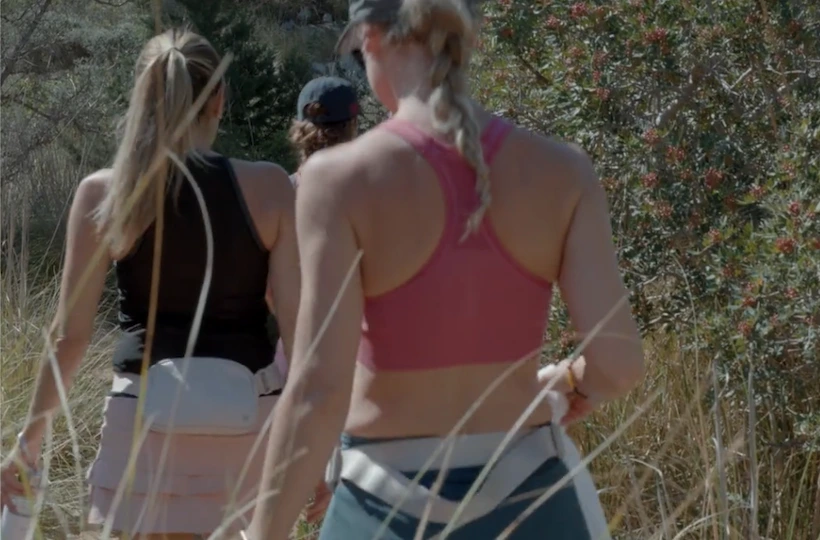
The Serra de Tramuntana is a UNESCO World Heritage site and one of the best hiking ranges in the Mediterranean, laced with centuries-old dry-stone paths, the long-distance GR-221 route, and dozens of shorter day hikes ranging from gentle coastal walks to serious mountain scrambles. Here are the five I’d actually send you on, ordered from easiest to hardest.
| Hike | Distance | What it is | Effort |
|---|---|---|---|
| Sa Foradada | ~4 km round trip | Descent to a famous sea-pierced rock headland near Deià | Easy–moderate |
| Cala Deià coastal path | ~5 km | Olive terraces and coves between Deià and Llucalcari | Easy–moderate |
| Sant Elm → La Trapa | ~7 km round trip, ~350m gain | Pine forest and coastline to a ruined Trappist monastery, with Sa Dragonera island offshore | Moderate |
| Camí de s’Arxiduc | ~8–14 km circuit, ~695m gain | The Archduke’s ridge trail above Valldemossa — the classic Tramuntana walk | Moderate |
| Puig de Galatzó | ~10 km, steep | The southwest’s signature peak, from Es Capdellà | Challenging |
Sa Foradada is the one to do if you only do one. It’s a descent from the road toward the sea, ending at a huge rock with a hole punched through it, and there’s a restaurant at the bottom with a view worth the climb back up. Steep in places but genuinely accessible.
Camí de s’Arxiduc is the walk people mean when they talk about hiking Mallorca. Built by Archduke Ludwig Salvator of Austria, it runs the ridge between Valldemossa and Deià, mostly flat once you’re up, with the coastline dropping away on one side. There’s a longer 14 km circuit and shorter variations — pick based on the day’s heat.
Puig de Galatzó is the closest real peak to Calvià, which makes it the natural choice if you’re staying in the southwest. It’s a proper climb. Start at dawn.
Read this before you go:
- Start early. In summer this is not advice, it’s the whole plan. On the trail by 7am, off by noon.
- Bring more water than feels reasonable. Two liters minimum for anything over two hours.
- Real shoes. Tramuntana limestone is slick, uneven, and unforgiving of sandals.
- Torrent de Pareis appears on every “best hikes” list. It’s a canyon scramble, not a walk — only in dry, settled conditions, and better with a guide. Skip it unless you’re an experienced scrambler.
- Many trailheads are reachable by bus from Palma if you’re not renting a car, though a car makes everything easier.
Mallorca’s markets, by day
Nearly every town on Mallorca has a weekly market, and Palma’s three municipal food markets — Mercat de l’Olivar, Mercat de Santa Catalina, and Mercat de Pere Garau — run Monday through Saturday mornings. Going to a market here isn’t shopping. It’s the closest you’ll get to how the island actually lives.
In Palma:
| Market | When | What it is |
|---|---|---|
| Mercat de l’Olivar | Mon–Sat, roughly 7am–3pm | The big one. Fish, sobrasada, cheese, produce, plus bars where you eat it on the spot |
| Mercat de Santa Catalina | Mon–Sat mornings | Palma’s original market, open since 1905. Smaller, mellower, more neighborhood |
| Mercat Ecològic | Tuesdays & Saturdays, 8am–2pm, Plaça dels Patins | Organic growers only. Quiet, seasonal, small |
Mercat de l’Olivar is where chefs shop before service. Go hungry, order at one of the bar counters, and eat standing up.
Mercat de Santa Catalina is the one I’d pick. Family stalls going back decades, women shopping with woven palm baskets, olives and Mallorcan cheeses and Balearic wines, and cafés inside where the right move is tapas at 11am for no particular reason.
Around the island, the weekly town markets are worth planning a morning around: Sóller and Santanyí on Saturdays, Pollença and Alcúdia on Sundays, Sineu on Wednesdays (the oldest on the island, in the geographic center), Inca on Thursdays (the biggest), Deià and Santanyí on Wednesdays for artisan goods, Artà on Tuesdays.
The Rastro de Consell flea market runs Sunday mornings and is the island’s great second-hand hunting ground. There’s also a Saturday-morning flea market at Son Bugadelles in Calvià, which is the closest one to the southwest.
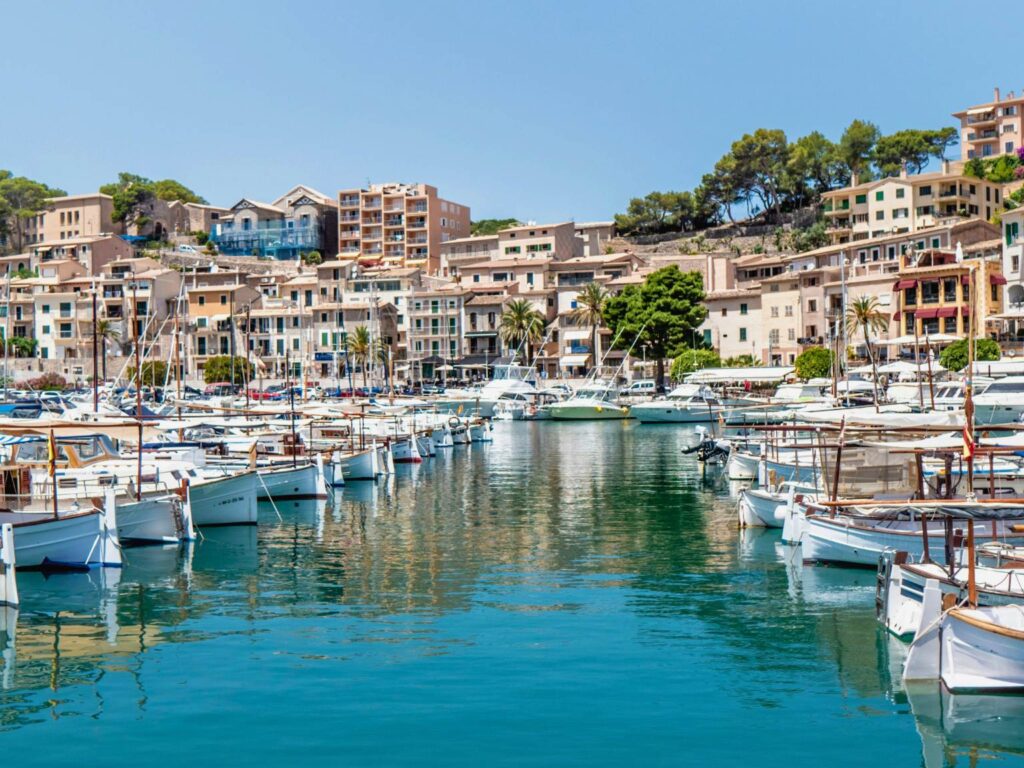
Where to buy natural fibers, ceramics, and things made on the island
Mallorca has a real craft tradition, and it’s worth knowing what to look for rather than what to avoid.
Roba de llengües — “tongue cloth” — is the island’s signature textile: blue-and-white flame-patterned fabric made with an ikat resist-dye technique that predates almost everything else you’ll see. Real ones are woven on Mallorca. Look for it at Estilo Sant Feliu in Palma, which carries both llengües textiles and ceramics.
Ceramics. Terra Cuita has been making Mallorcan pottery since 1860. Hansen on Carrer de l’Argenteria is a small shop full of local ceramics and artisan work. And the siurell — a little white-and-red whistling clay figure — is the traditional island piece, still made by hand.
Natural fibers and slow fashion. Cortana is the Mallorcan label to know: made exclusively from natural fabrics, produced in small workshops in Mallorca and Barcelona, with a flagship space in central Palma. Their homeware line includes ceramics and blown glass made with island craftsmen. Tree of Life in La Llonja carries handcrafted and independent-designer pieces if you want something more bohemian.
Espadrilles and palm baskets. Alpargatería La Concepción is one of Palma’s protected historic shops, and the esparto-grass baskets hanging in the doorway are the thing every woman on this island carries. Buy the basket. You’ll use it forever.
Where to wander: Carrer de Sant Feliu for galleries and design boutiques, Santa Catalina for independent shops and Balearic design, La Llotja for the artisan cluster in the old town.
Herbolarios, salt, and the quieter kind of magic
Mallorca’s version of this is less crystal-shop and more Mediterranean-old — herbs, salt, olive oil, and a lot of history you can walk into.
Herbolarios. Spain has a strong herbolario tradition — small herbal and natural-remedy shops, common in Palma and most towns. You’ll find bulk herbs, tinctures, teas, and natural body care, usually run by someone who knows exactly what they’re selling. Ask for hierbas mallorquinas, the local herb blend used in the island’s famous digestif.
Flor de Sal d’Es Trenc. Hand-harvested salt from the flats near Es Trenc on the south coast, blended with things like hibiscus, black olive, and Mediterranean herbs. It’s the single best thing to bring home and weighs nothing.
Olive oil. Mallorca has its own protected designation, and many Tramuntana fincas press their own. If you’re offered a tasting, take it.
Valldemossa’s Cartoixa — the old Carthusian monastery where Chopin and George Sand spent a famously miserable winter — is worth the visit for the cloister and the pharmacy, which still holds its original apothecary jars.
Caves. Mallorca is riddled with them. The show caves on the east coast are dramatic but busy. If you want the quiet version, the Tramuntana is full of archaeological cave sites tucked into the rock, some of them prehistoric.
Come practice on this island with us
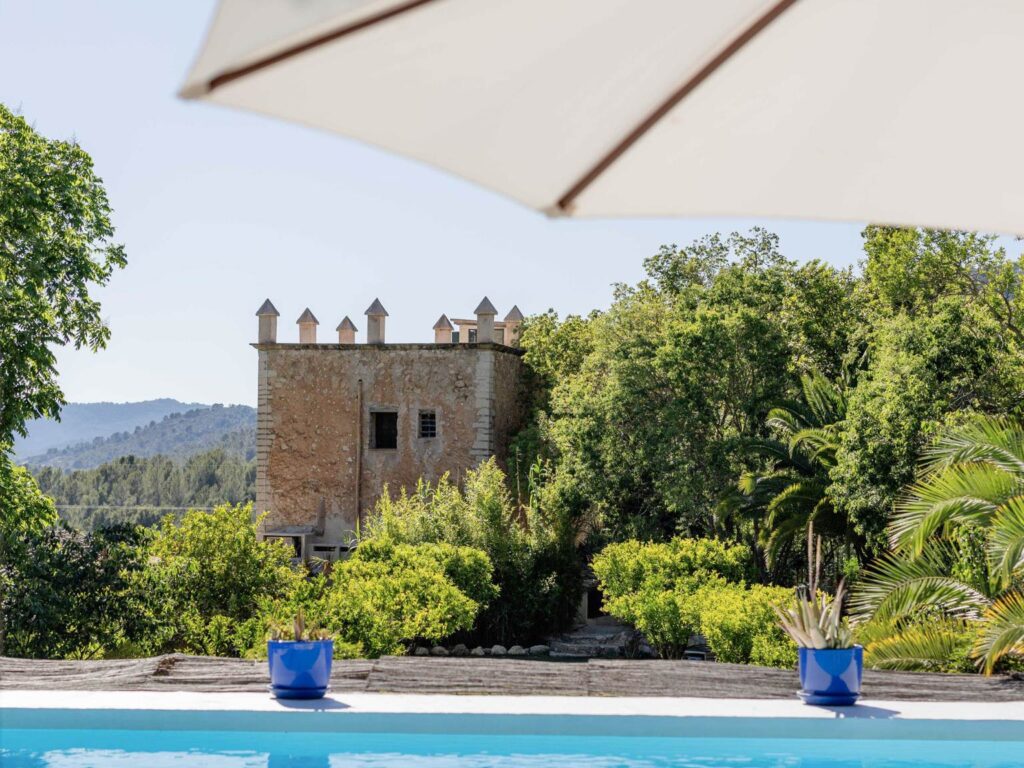
Next summer I’m bringing a small group of women to Sol & Soul — a restored 17th-century finca in the Calvià valley, at the foot of the Tramuntana, twenty minutes from Palma and surrounded by olive and almond groves.
Two practices a day, mountain and sea, long meals under the trees, and a week built around joy rather than recovery. You don’t have to arrive depleted to deserve this. You’re allowed to just want something beautiful.
Most women come alone. Most have never been on a retreat before — if that’s you, here’s what to expect at your first yoga retreat, start to finish. And here’s what a week on a yoga retreat in Spain actually looks like, day by day.
See the Sol & Soul Mallorca retreat →
Not sure what to bring? Here’s exactly what to pack for a Mallorca yoga retreat — heat, hikes, dinners, and all.
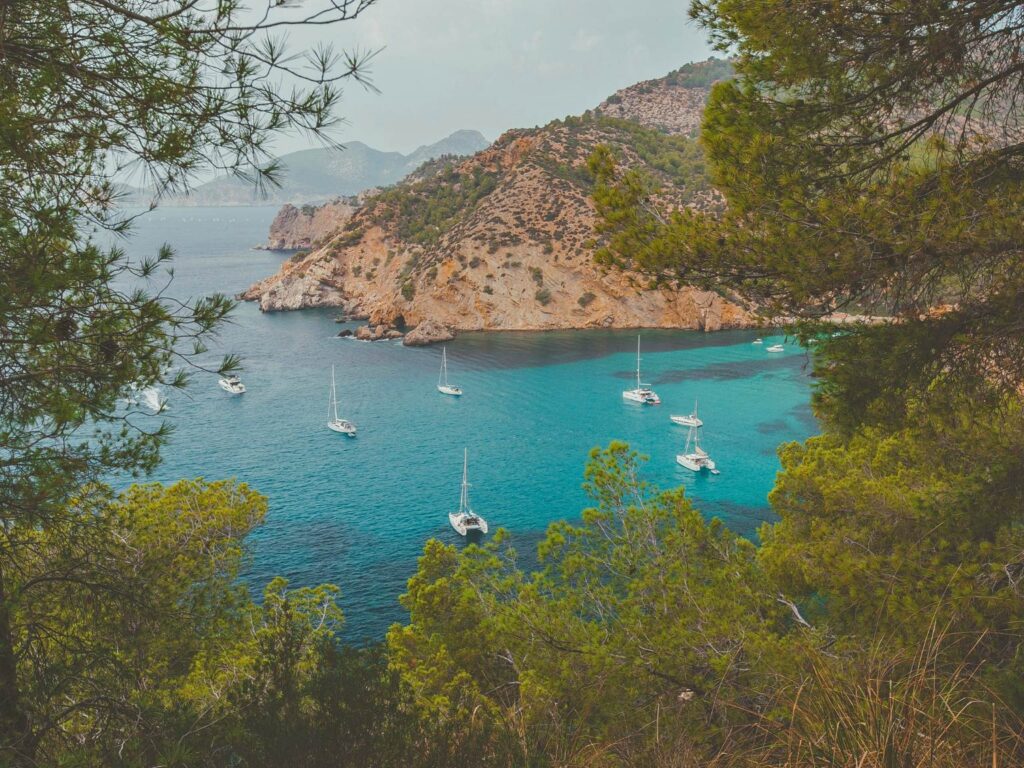
The not-so-yogi part: wine, long lunches, and swimming
You can practice at eight in the morning and drink Mallorcan red at a table under a fig tree at three. Both things are true here. I’d argue the long lunch is the practice.
Wine. Mallorca has two protected wine regions — DO Binissalem in the center and DO Pla i Llevant in the east — and the island grows indigenous grapes you won’t find elsewhere: Manto Negro and Callet for reds, Prensal Blanc for whites. Most bodegas take visitors. Ask for something local rather than a Rioja; the whole point is that these grapes only grow here.
Where to eat. Santa Catalina is Palma’s food neighborhood, full stop — dozens of restaurants in a few walkable blocks, plus the market at its center. La Llotja and the old town cover the classic side. Order pa amb oli (bread, oil, tomato, and whatever’s on it) at least once, and eat an ensaïmada — the spiral pastry that’s the island’s signature — from a proper bakery rather than an airport.
Swimming. The southwest coast near Calvià has cove after cove. Further up, Cala Deià is the famous one — a rocky cove below the village with restaurants at the water’s edge, reachable on foot along the coastal path. Go early or go at six; midday in August belongs to everyone else.
Palma itself. The cathedral, La Seu, is genuinely worth an hour, particularly the Gaudí interventions and the Miquel Barceló chapel. Es Baluard, the contemporary art museum, sits on the old sea walls with one of the best views in the city. The Fundació Miró is on the western edge of town and holds the studio Miró worked in for decades.
The Sóller train, and the one day trip worth the effort
The Tren de Sóller is a wooden narrow-gauge train that has run from Palma through the Tramuntana to Sóller since 1912, and it’s the single best day trip on the island. An hour of citrus groves, tunnels, and mountain views in lacquered wood carriages with brass fittings and windows that actually open.
At Sóller, connect to the vintage tram down to Port de Sóller — about fifteen minutes through orange groves to the harbor. A combined round-trip train and tram ticket booked online runs around €35, and a one-way train ticket about €23.
There are no reserved seats, so arrive early and pick your carriage. The train doesn’t run at all from mid-December through January for maintenance. Timetables shift between summer and winter — check before you go.
Make a day of it: train up, tram down, swim at the port, lunch, and take the late tram back. Sóller’s own Saturday market is worth timing for.
Events worth planning your trip around
Nit de l’Art · Palma · mid-September One night in September when Palma’s galleries, museums, and cultural spaces throw open their doors free until late, and the old town, La Llotja, and Santa Catalina turn into an open-air art circuit. It started in 1997 and has grown into one of Europe’s better-known contemporary art nights. Free entry, festive, plenty of cava. The 2026 edition — the 30th — is set for Saturday, September 19. If your trip runs into mid-September, build around it.
Art Palma Brunch (March) and Art Palma Summer (June) are the same organization’s other two annual events, if your timing is different.
Village fiestas. Every town on Mallorca has its own patron saint festival, and late summer is thick with them — processions, fireworks, correfocs where people run through the streets with fireworks, music in the plaza until very late. These aren’t put on for visitors, which is exactly why they’re worth going to. Ask locally what’s happening the week you’re there; the town hall website or a bar owner will know.
Harvest season. Late August into September is the start of the verema, the grape harvest, and the almond harvest follows. Bodegas run tastings and harvest events through this stretch.
Markets (above) are the reliable weekly event. If you do nothing else, do a Saturday market.
If you only have 48 hours
Here’s how I’d stack yoga in Mallorca with everything else if the clock is tight.
Day one: Morning class at Earth Yoga in Santa Catalina. Straight to the Mercat de Santa Catalina for tapas and a wander. Afternoon out of the heat — La Seu cathedral, then Es Baluard. Swim at six. Dinner in Santa Catalina, late, outside.
Day two: Early. On the Sa Foradada trail by 7:30, down to the sea, back up before it’s too hot. Lunch in Deià. Afternoon in Valldemossa — the Cartoixa, the streets, an almond cake. Back to Palma for the golden hour and a glass of Manto Negro.
If you have a third day: the Sóller train, all day, no rushing.
Frequently asked questions
Is Mallorca good for a yoga retreat? Yes. Mallorca is one of the most popular yoga retreat destinations in Europe, with a large concentration of retreat venues in restored rural fincas, a well-established studio scene in Palma, a UNESCO-protected mountain range for hiking, and reliable warm weather from May through October. Most classes on the island are taught in English.
When is the best time to visit Mallorca for a yoga retreat? Late spring and early autumn are the most comfortable. May, June, September, and early October offer warm weather and swimmable sea without peak-summer heat and crowds. July and August are hot — practical for a retreat if activities are scheduled early and late in the day, which is how most island life runs in summer anyway.
Can I drop into a yoga class in Palma as a visitor? Yes. Most Palma studios accept drop-ins without a membership, and the majority of classes are taught in English. Earth Yoga in Santa Catalina is the easiest for visitors and generally doesn’t require pre-booking. Some smaller studios do ask you to reserve a spot in advance.
What is the best yoga studio in Palma de Mallorca? Earth Yoga in the Santa Catalina neighborhood is the best choice for most visitors — it’s one of Palma’s longest-running studios, offers a wide range of styles across two rooms, teaches almost entirely in English, and takes walk-ins. Sadhana Works downtown and Yoga del Mar in Portixol are also strong options.
What are the best hikes in the Serra de Tramuntana? Sa Foradada near Deià is a short, accessible descent to a dramatic sea-pierced headland. The Camí de s’Arxiduc above Valldemossa is the classic ridge walk. Sant Elm to La Trapa climbs through pine forest to a ruined monastery with island views. The Cala Deià coastal path runs through olive terraces between coves. Puig de Galatzó is the southwest’s main peak and a serious climb. In summer, start all of them by 7am.
Do I need a car in Mallorca? Not strictly, but it helps. Palma is fully walkable, buses reach most towns and many Tramuntana trailheads, and the Sóller train covers the best scenic route. A car makes coves, villages, and early trailhead starts far easier, especially if you’re staying somewhere rural.
What should I buy in Mallorca? Roba de llengües, the blue-and-white ikat textile woven on the island. Hand-thrown ceramics. Flor de Sal d’Es Trenc, hand-harvested salt from the southern flats. Local olive oil. Esparto-grass palm baskets and espadrilles. Balearic wine made from indigenous Manto Negro or Prensal Blanc grapes.
What day are the markets in Mallorca? Palma’s municipal markets — l’Olivar, Santa Catalina, and Pere Garau — run Monday through Saturday mornings. Around the island: Sineu on Wednesdays, Inca on Thursdays, Sóller and Santanyí on Saturdays, Pollença and Alcúdia on Sundays. The Rastro de Consell flea market runs Sunday mornings.
Is the Sóller train worth it? Yes. The Tren de Sóller has run since 1912 in original wooden carriages, and the hour-long journey through the Tramuntana and its citrus groves is the best scenic trip on the island. Connect to the vintage tram down to Port de Sóller. A combined round-trip ticket runs around €35 online. The train closes for maintenance from mid-December through January.
When is Nit de l’Art in Palma? Nit de l’Art takes place on one Saturday in mid-September each year, when Palma’s galleries, museums, and cultural spaces open free to the public into the night. The 30th edition is scheduled for Saturday, September 19, 2026. Entry is free and no booking is required for most venues.
Is there a women’s yoga retreat in Mallorca? Yes. Ambuja Yoga runs Sol & Soul, a women’s yoga retreat at a restored 17th-century finca in the Calvià valley at the foot of the Serra de Tramuntana, about twenty minutes from Palma. It combines two daily yoga practices with hiking, sea swimming, island food, and Mallorcan wine, and it’s open to all levels, including women who have never been on a retreat before.
What should I pack for a yoga retreat in Mallorca? Layers for hot days and cooler evenings, trail shoes for the Tramuntana, a swimsuit you’ll live in, sun protection, and one outfit you feel good in for dinner. Most retreat venues provide mats and props. Full detail is in the Mallorca packing guide.
About the author
Autumn Adams is the founder of Ambuja Yoga and an E-RYT 500, YACEP yoga teacher based in Bend, Oregon. She has been leading women’s yoga retreats since 2014 — 13 years, 40+ retreats, and more than 700 women across the U.S., Chile, Spain, Greece, Thailand, and beyond. She hosts The Aligned Yogi Podcast and wrote The Little Book of Mudra Meditations. Her retreats have been featured in Insider, Shape, Zappos, and Asia Spa.
She leads Sol & Soul, a women’s yoga retreat in the Calvià valley of Mallorca, each summer.
More about Autumn and Ambuja Yoga →
One brave decision
If you’ve been opening retreat pages late at night and closing them again, this is your nudge.
Sol & Soul · Calvià, Mallorca · August 27 – September 3, 2027 A restored 1600s finca · small group · all levels · most women come alone
See dates, pricing, and what’s included →
Love, Autumn
About the Author
Autumn Adams
E-RYT, YACEP, Founder of Ambuja Yoga
Autumn Adams (E-RYT 500, YACEP) is the founder of Ambuja Yoga, where she's led women's yoga retreats since 2014 — 40+ retreats and 700+ women across Oregon, North Carolina, Sedona, Patagonia, Greece, Mallorca, and Thailand. Her work has been featured in Insider, Shape, Zappos, Asia Spa, Direct Holiday, and Bend Nest, and she's the author of The Little Book of Mudra Meditations.
Upcoming Retreats
Ready to experience the magic for yourself? Explore our upcoming retreat offerings.
 Popular
UnBound: Women’s Yoga Retreat in Patagonia, Chile
Apr 10 - 17, 2027
Rewild your spirit in Chilean Patagonia.
You Might Also Enjoy
Not Sure You Want Yoga All Day? What an Adventure Wellness Retreat for Women Is Really Like
You don’t have to love yoga to love an adventure wellness retreat for women. On…
What to Pack for a Yoga Retreat in Mallorca: The Sol & Soul List, Day by Day
Most packing lists for a yoga retreat in Mallorca are written for a generic week.…
Festes del Rei en Jaume: Why You Should Stay One More Day in Mallorca
Every year, the town fifteen kilometers down the hill from our finca reenacts the night…