
Patagonia in April: What It’s Actually Like in the Puelo Valley
13 years · 40+ retreats · 700+ women



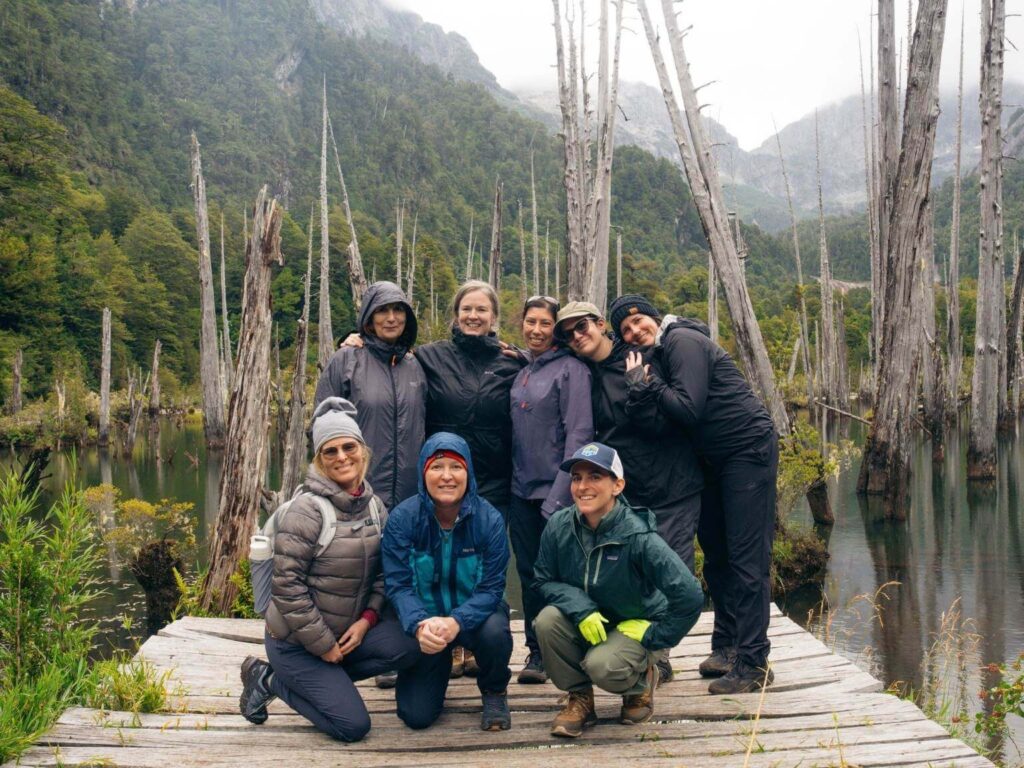
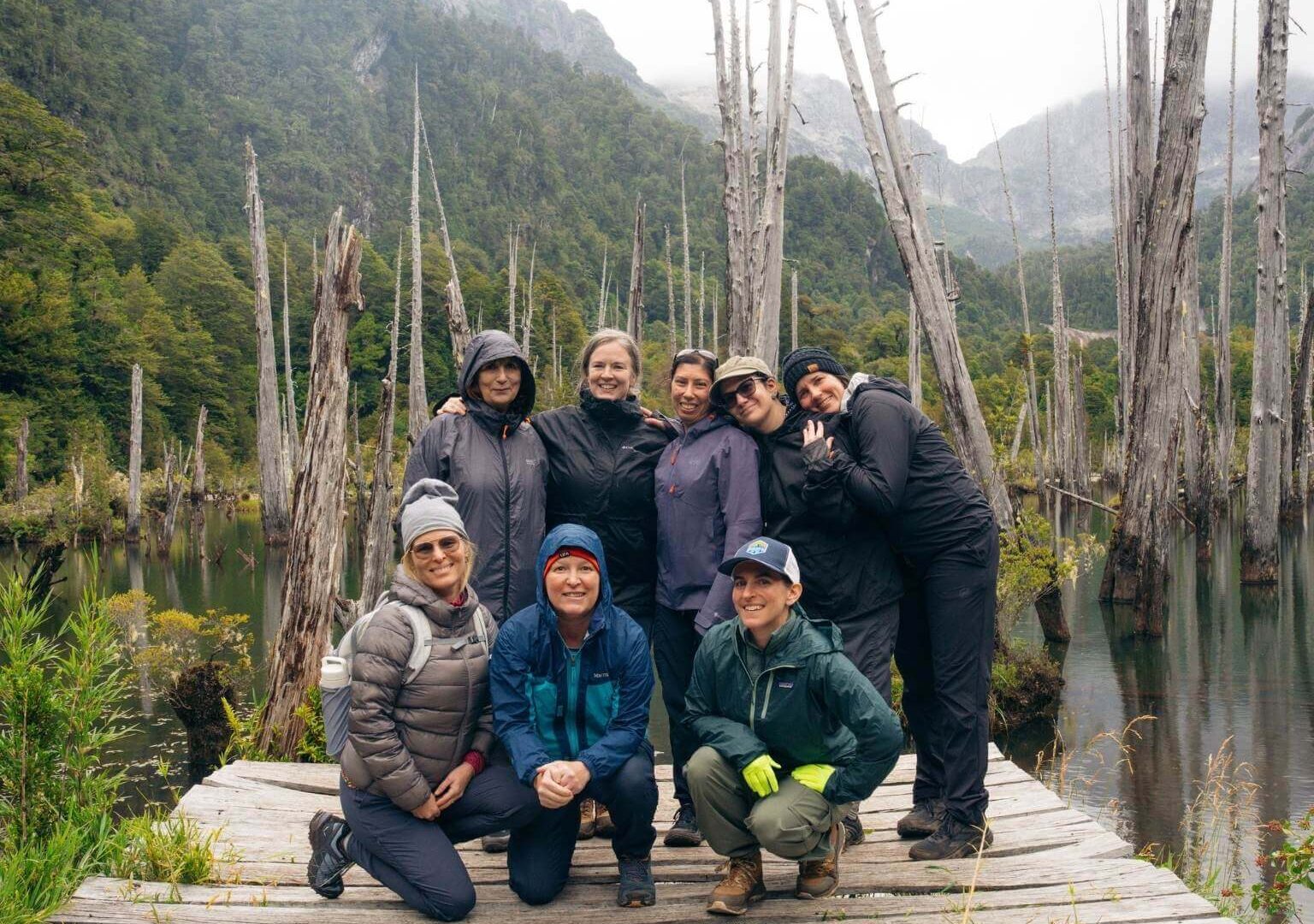
Patagonia in April is cool, quiet, and gold. Days run in the mid-50s°F, the lenga forests turn red and copper, the summer crowds are gone, and the biting flies that make January miserable have disappeared entirely. In northern Patagonia — the Puelo Valley in Chile’s Lake District, where we host our retreat — April is mild in a way that surprises people who only know Patagonia from photos of wind-scoured southern peaks.
Here’s the thing that convinced me. All three of our guides and our venue manager, independently, told me April is their favorite month of the year. These are people who live there. They have all twelve months to choose from. They picked this one.
So let me tell you what they’re talking about.
In this post
- What is Patagonia like in April?
- Is April mushroom season in Patagonia?
- Why do the guides say April is the best month?
- How cold is Patagonia in April?
- Does it rain in Patagonia in April?
- Why northern Patagonia instead of southern Patagonia?
- What can you actually do there in April?
- What should you pack?
- Is April a good time for a Patagonia yoga retreat?
- FAQ
What is Patagonia like in April?
April in Patagonia is mid-autumn — the southern hemisphere’s answer to October. Daytime highs in the Chilean Lake District sit around 57°F (14°C) and nights drop to about 41°F (5°C). You get roughly eleven hours of daylight, and the light comes in low and slanted almost all day, the way it does at home in the last weeks of fall.
The forests are the headline. Southern beech — lenga and ñirre — turn red, orange, and gold against grey granite and dark evergreen. The lakes go still. Peak season ends in February, so by April the trails and the water are largely empty.
And the tábanos are gone. If you’ve never been to Patagonia in summer, you may not know about the horseflies — they peak from mid-December through January and they are genuinely, famously awful. By autumn there isn’t one left. Nobody puts that in the brochure. It matters enormously.
If you know the Pacific Northwest, you already know this place
The Chilean Lake District is the Pacific Northwest’s mirror image. Same maritime coast, same volcanoes lined up along a spine of mountains, same fjords, same soaked green rainforest. If you’ve spent time on the Olympic Peninsula or up the BC coast, your body will recognize this valley within an hour of arriving.
With one difference. The forest here is southern beech, not conifer — so in April it turns. Red, copper, gold, all the way up the hillsides. It’s the PNW you know, doing the one thing the PNW never does.
Is April mushroom season in Patagonia?
Yes — autumn is peak fungi season in southern Chile, and April sits right in the heart of it. This is one of the most fungally rich temperate forests on the planet, and the forest floor in April is a completely different world than the same trail in January.
Southern beech is the reason. Nothofagus forest supports an enormous range of fungi, much of it found nowhere else on earth. Walk slowly and you’ll start seeing them everywhere: Cortinarius magellanicus in deep violet, coral fungi branching up out of the moss like something underwater, tiny blue Mycena on a rotting log, and the unmistakable red-and-white Amanita muscaria — the storybook one.
Chile takes this seriously in a way almost no other country does. It was among the first nations in the world to write fungi into its environmental impact law, largely through the work of Chilean mycologist Giuliana Furci and the Fungi Foundation, the first organization on earth dedicated to protecting fungi. There’s a fungi festival in Pucón every May.
For us it changes the pace of the walking. We move slower in April, and the group ends up crouched over things. It’s one of the small unexpected pleasures of this month — the kind of looking you probably haven’t done since you were a kid, on your knees in wet moss, delighted by something the size of your thumbnail.
Look, photograph, leave them where they are. Our guides know what’s what, and you don’t want to be the woman who finds out the hard way.
Why do the guides say April is the best month?
Because April is when the valley belongs to the people who live there again. That was the substance of what all three of our guides and our manager told me, in slightly different words.
Summer in the Puelo Valley is beautiful and busy. Boats running, lodges full, everyone working. April is after. The color is at its peak, the water is glassy, the air is clean and cold in the mornings, and there’s nobody on the trail ahead of you. One of them described it as the month the valley exhales.
I’ve been leading retreats for thirteen years, and I’ve learned to weight local opinion heavily over travel-blog consensus. Travel blogs will tell you to go to Patagonia in January. The people who live there will tell you to go in April. I trust the second group.
Full disclosure: I’ve led a retreat in Patagonia in January and yes it was amazing. I almost booked it again, but when all of our guides said “You’ve got to come in fall,” I booked fall.
How cold is Patagonia in April?
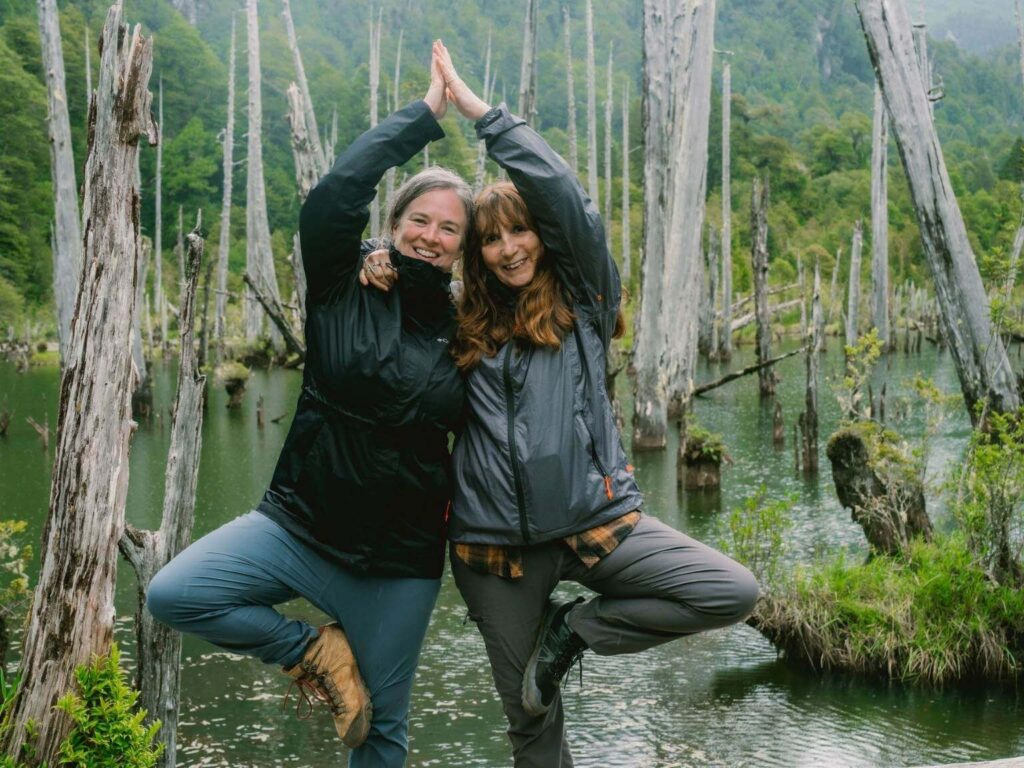
Northern Patagonia in April is cool but not harsh — think 57°F days and 41°F nights, similar to a New England October. It is not the punishing cold people picture when they hear “Patagonia.”
What actually determines your comfort is layers and dry feet, not temperature. Mornings are sharp — you’ll want a hat and gloves for the first hour of the day. By midday, hiking uphill in the sun, you’ll be down to a base layer. Evenings turn cold quickly once the sun drops behind the ridge, which is exactly when the woodstove and the hot springs stop being a nice extra and start being the best part of the day.
The one thing worth saying plainly: your hands and feet decide how much you enjoy this trip. Bring the good gloves. Bring the wool socks.
Does it rain in Patagonia in April?
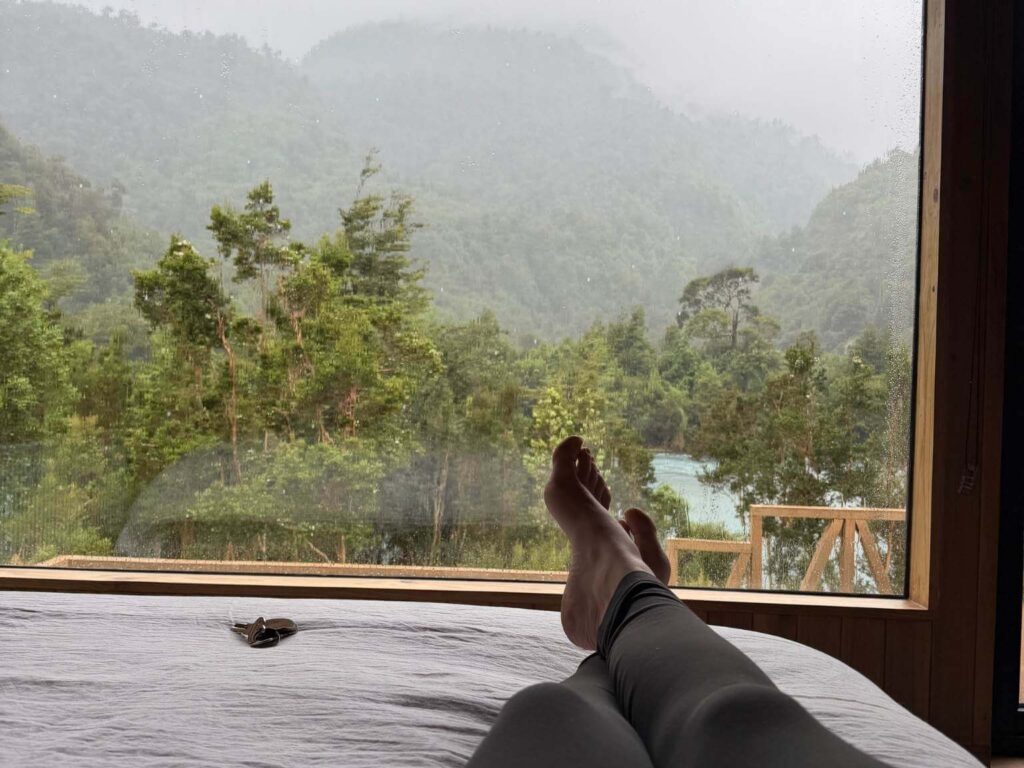
Yes. April is one of the wetter months in the Chilean Lake District, and pretending otherwise would be a disservice. This is temperate rainforest — the region takes in over 130 inches of rain a year, and February is the driest month, not April.
Here’s the honest trade. You give up the driest weather and you get the color, the quiet, the empty water, and no flies. Our guides made that trade knowingly, and so did we when we set the dates.
Two things soften it. The rain here tends to come in bursts rather than all-day drizzle, so a wet morning is often a clear afternoon. And as you travel up the valley toward the Argentine border, the Andes wring a lot of the moisture out — the farther east you go, the drier and more open it gets. Which is exactly the direction we head.
Rain gear isn’t a contingency on this trip. It’s equipment. Bring the real jacket.
Why northern Patagonia instead of southern Patagonia?
Northern Patagonia is milder, greener, and far less windy than the southern parks most people picture. The Puelo Valley sits at about 41°S in Chile’s Lake District — roughly the latitude of Rhode Island, mirrored. Torres del Paine is a thousand miles further south.
That distance is the whole difference. Southern Patagonia in April means genuinely cold, genuinely short days, services shutting down for winter, and the wind that region is legendary for. Northern Patagonia in April means fall color, forest, rivers, hot springs, and weather you can actually spend a week outside in.
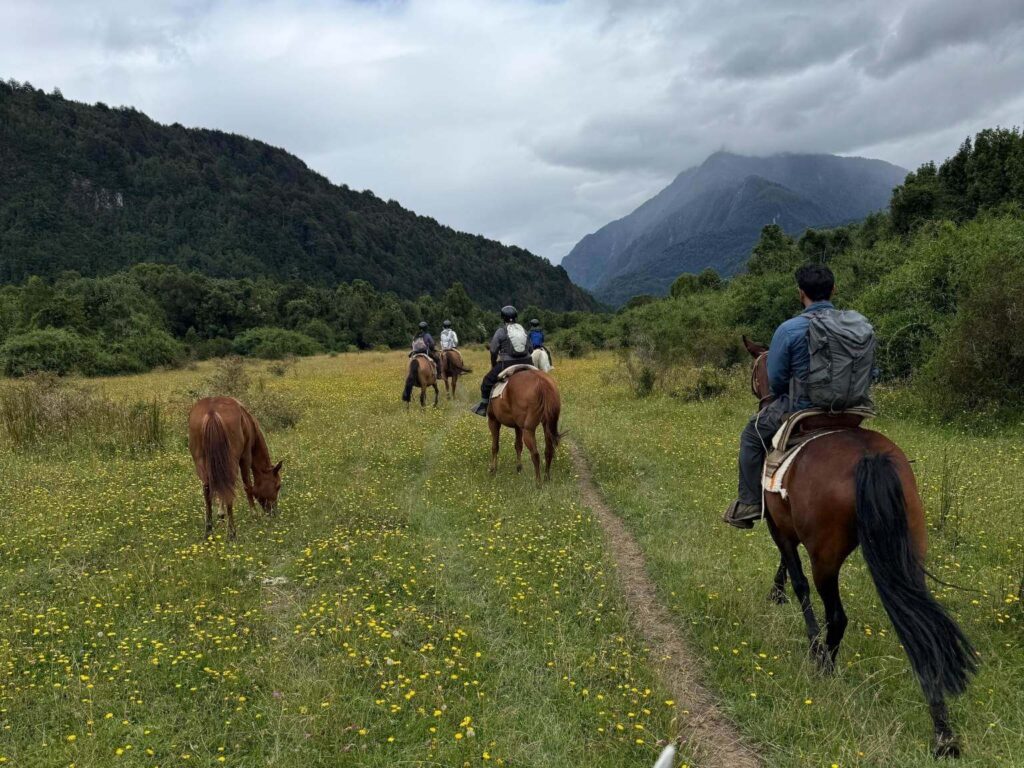
It’s also a working landscape rather than a park. There are gauchos here, and small farms, and families who have run cattle in these valleys for generations. You reach places by boat and on foot because the roads are limited. That does something to a person that a tour bus to a viewpoint does not.
What can you actually do there in April?
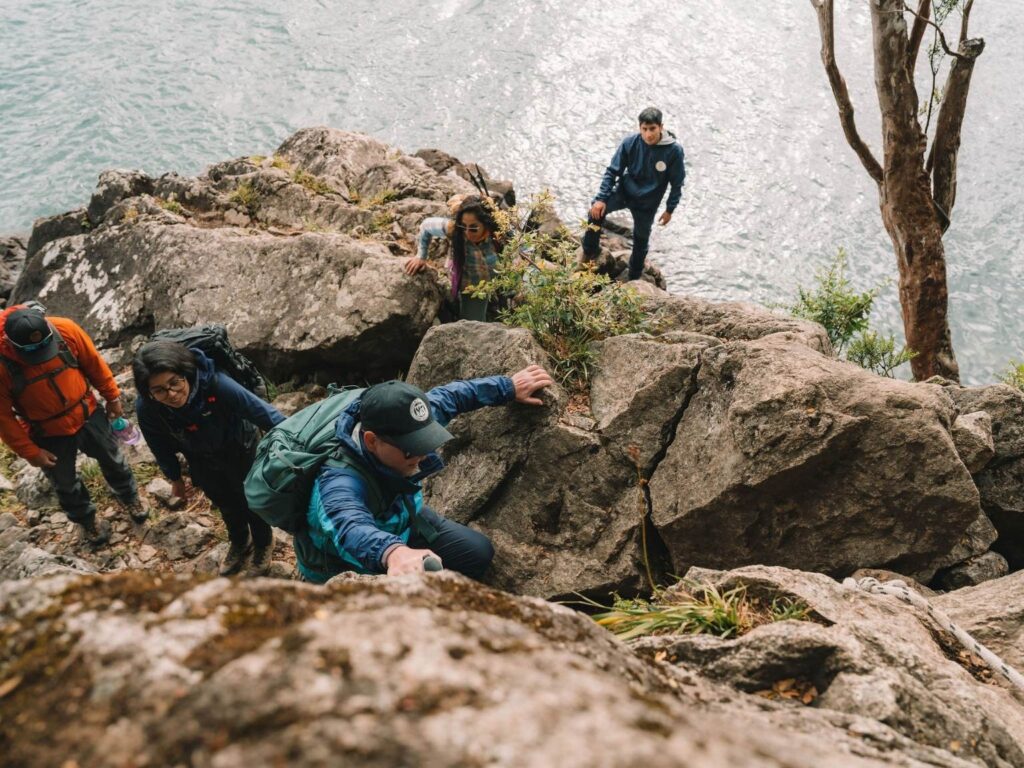
The Puelo Valley in April is built for water, forest, horses, and hot water at the end of the day. On our retreat week that means:
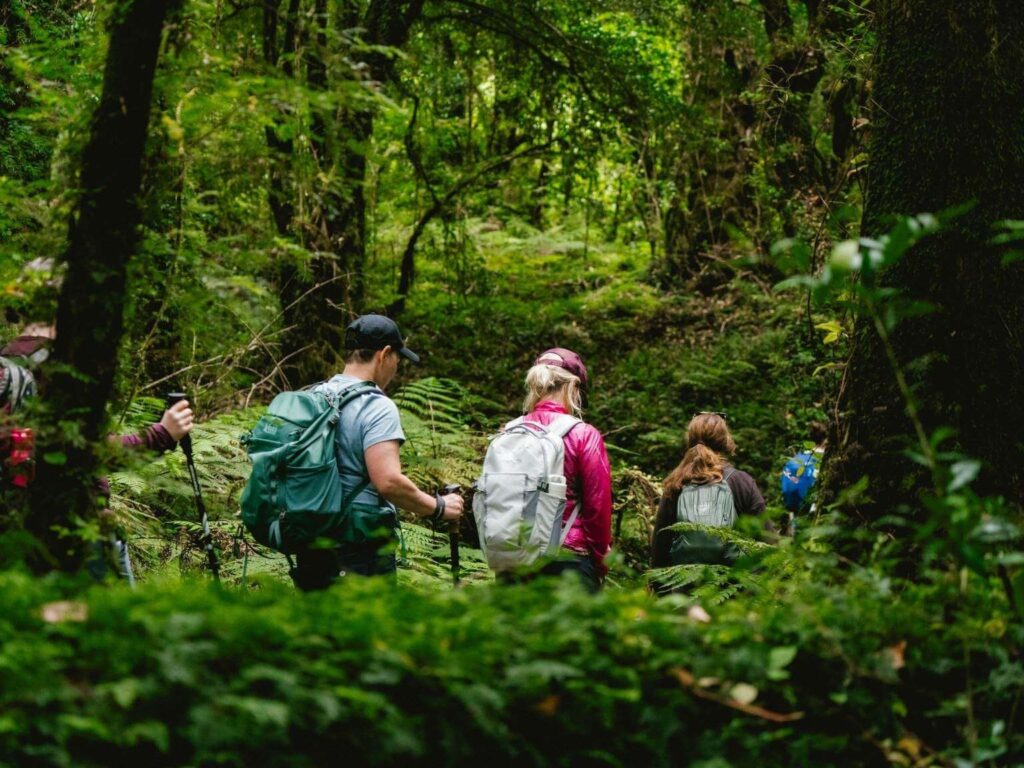
- Boat and trek into gaucho country. There’s no road into the upper valley. You go by boat across the lake and then on foot, into country where the horse is still the pickup truck.
- Kayak Lago Tagua Tagua. Autumn is when the lake goes glassy. Summer wind flattens out, and you paddle through the reflection of the color on the hillsides.
- Soak in volcanic hot springs at the foot of Volcán Yate. Cold air, hot water, steam, the volcano above you. This is the part women talk about for years.
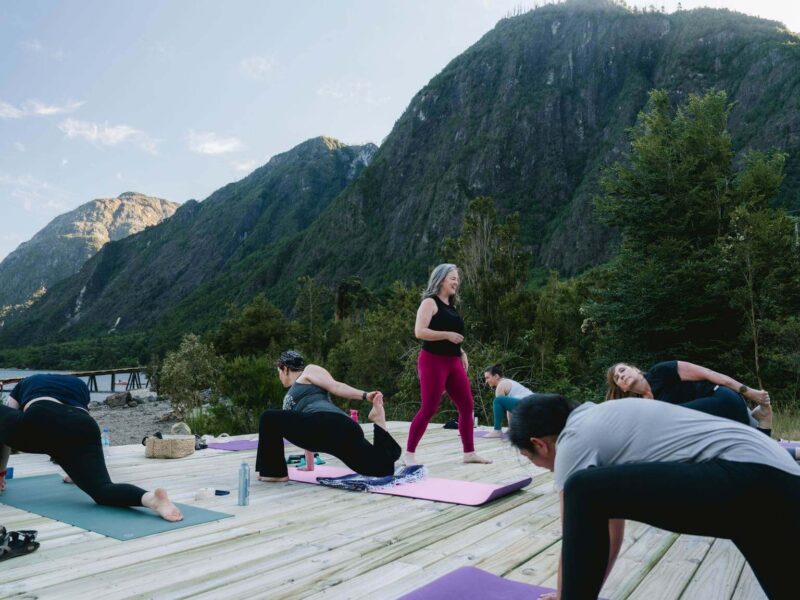
- Yoga, twice a day, in a valley with no one else to prioritize, but you. Mornings to wake the body up before we move. Evenings to soften and unwind.
Nothing here requires you to be an athlete. It requires you to be willing to be outside in weather, which is a different and much more available thing. On our last trip, we laughed so hard in the rain. It felt like we were kids again.
Come see it for yourself
Patagonia UnBound — our women’s yoga and adventure retreat in the Puelo Valley, Chile — runs April 10–17, 2027. Fourteen women. Boats, forest, horses, hot springs, and two practices a day. From $4,497.
See the retreat and full itinerary →
Not ready to decide? Get the Patagonia packing list — the actual one we send our guests, including what layers to bring for April.
What should you pack for Patagonia in April?
Pack for cold mornings, mild afternoons, and rain at any hour — layers, not bulk. The short version:
- A genuinely waterproof shell jacket and rain pants (not water-resistant — waterproof)
- Broken-in waterproof hiking boots, plus camp shoes
- Wool socks, more than you think
- Warm hat and gloves
- Base layers, a fleece or light puffy, and a warm layer for evenings
- Swimsuit and a quick-dry towel for the hot springs
- Headlamp — sunset comes early
- One thing that makes you feel like yourself. Every woman I’ve watched pack for this trip forgets that one.
Is April a good time for a Patagonia yoga retreat?
April is arguably the best time for a Patagonia yoga retreat in the northern valleys, because the weather is mild enough to be outside all day and quiet enough to actually hear yourself.
That second part is the reason we go in April rather than January. The valley in autumn is genuinely still. There’s no boat traffic, no other groups on the trail, no notifications going off every 5 minutes. Your nervous system notices that before your mind does.
And I want to name what’s underneath all of this, because it’s easy to sell a retreat on rest alone and rest is only half of it. Yes, you’ll sleep. Yes, you’ll stop being needed by anyone for a week. But the reason we get on the boat is not to escape your life. It’s the part that happens after the rest — the laughing on the water, the ridiculous joy of getting into hot water when it’s 45°F out, the moment on a trail where you realize your body still knows how to do hard, beautiful things.
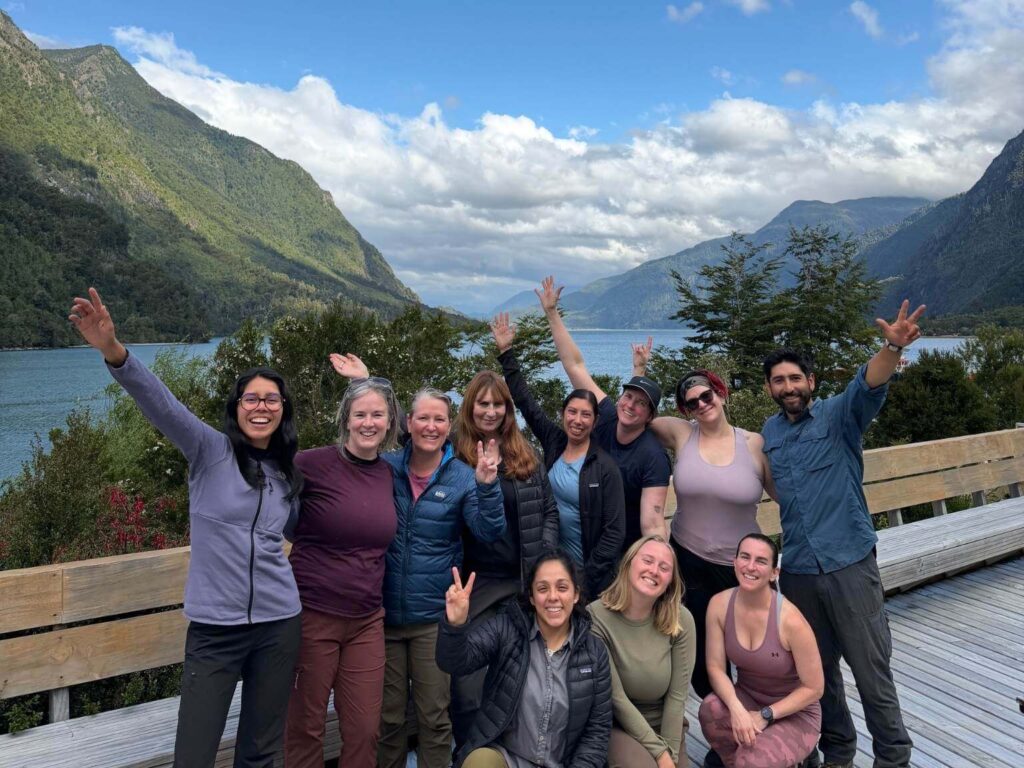
You don’t have to earn that. You don’t have to be fully rested, fully fit, or fully sure to come. Most of the women on these trips arrive tired and alone and leave neither.
Patagonia in April FAQ
Is April a good time to visit Patagonia? April is an excellent time to visit northern Patagonia and a harder call in the south. In the Chilean Lake District you get fall color, mild days around 57°F, no summer crowds, and no biting flies. In southern Patagonia, April brings colder weather, shorter days, and services closing for winter.
How cold does it get in Patagonia in April? In northern Patagonia, expect daytime highs near 57°F (14°C) and overnight lows near 41°F (5°C). Mornings are cold enough for a hat and gloves; afternoons in the sun are often shirtsleeve weather while hiking.
Does it rain a lot in Patagonia in April? Yes — April is one of the wetter months in the Chilean Lake District, which is temperate rainforest. Rain typically arrives in bursts rather than all day, and the upper valley toward Argentina is noticeably drier than the coast. Fully waterproof outerwear is essential.
Are there bugs in Patagonia in April? No. The tábanos (horseflies) that swarm the region from mid-December through January are completely gone by autumn. This is one of the strongest practical arguments for visiting Patagonia in April instead of midsummer.
How many hours of daylight are there in Patagonia in April? About eleven hours in northern Patagonia in mid-April, with long, low, golden light through most of the day. Plan on being back before dark and carrying a headlamp.
Where is the Puelo Valley? The Puelo Valley is in the Cochamó area of Chile’s Los Lagos Region, in northern Patagonia, roughly 41°S. The Río Puelo flows from Argentina through Lago Tagua Tagua toward the Reloncaví Estuary. The upper valley has no road access — you reach it by boat and on foot.
Do I need to be an experienced hiker or yogi to come on a Patagonia yoga retreat? No. You need to be comfortable walking several miles on uneven ground and willing to be outside in changeable weather. Yoga is offered at all levels, and most women who come on our retreats are not advanced practitioners.
Can I come alone? Yes, and most women do. The majority of guests on Ambuja retreats book solo. Shared rooms are matched with another woman traveling alone, and by the second day it stops feeling like a group of strangers.
One brave decision
Patagonia in April is not the easy, obvious, everybody-goes-then month. It’s the one the people who live there choose. Cold mornings, gold hillsides, still water, hot springs, and a valley with the volume turned all the way down.
If you’ve been reading this page more than once — and you probably have, because that’s how this decision usually goes — here’s your specific next step.
Patagonia UnBound · Puelo Valley, Chile · April 10–17, 2027 · 14 women Shared double from $4,997 · Quad from $4,497 · Private single $6,997
Sometimes one brave decision changes everything.
About the Author
Autumn Adams
E-RYT, YACEP, Founder of Ambuja Yoga
Autumn Adams (E-RYT 500, YACEP) is the founder of Ambuja Yoga, where she's led women's yoga retreats since 2014 — 40+ retreats and 700+ women across Oregon, North Carolina, Sedona, Patagonia, Greece, Mallorca, and Thailand. Her work has been featured in Insider, Shape, Zappos, Asia Spa, Direct Holiday, and Bend Nest, and she's the author of The Little Book of Mudra Meditations.
Upcoming Retreats
Ready to experience the magic for yourself? Explore our upcoming retreat offerings.
 Popular
UnBound: Women’s Yoga Retreat in Patagonia, Chile
Apr 10 - 17, 2027
Rewild your spirit in Chilean Patagonia.
You Might Also Enjoy

What to Pack for a Yoga Retreat in Mallorca: The Sol & Soul List, Day by Day
Most packing lists for a yoga retreat in Mallorca are written for a generic week.…
Festes del Rei en Jaume: Why You Should Stay One More Day in Mallorca
Every year, the town fifteen kilometers down the hill from our finca reenacts the night…
Mallorca in September and Late August: What It’s Really Like
The first question I get about the Mallorca retreat isn’t about the yoga. It’s about…